




Office cleaning contracts Dubai businesses can manage effectively should define every area, task, frequency, service window, quality measure, supply responsibility, exclusion and corrective action in writing. The price should follow a site survey and comparable scope, while the SLA should show how missed standards are reported, corrected and prevented from recurring.
A contract is more than an agreement to send cleaners. It is the operating document that turns workplace expectations into a deliverable service. When the scope, inspection method and change process are clear, facility managers can compare quotations fairly and hold the selected provider accountable.
This guide is written for office managers, procurement teams, landlords and commercial property decision-makers in Dubai. It supports the live MEBS office cleaning service in Dubai, which covers daily routines, deeper periodic work, flexible timings and supervised delivery for corporate workplaces.
What Is an Office Cleaning Contract in Dubai?
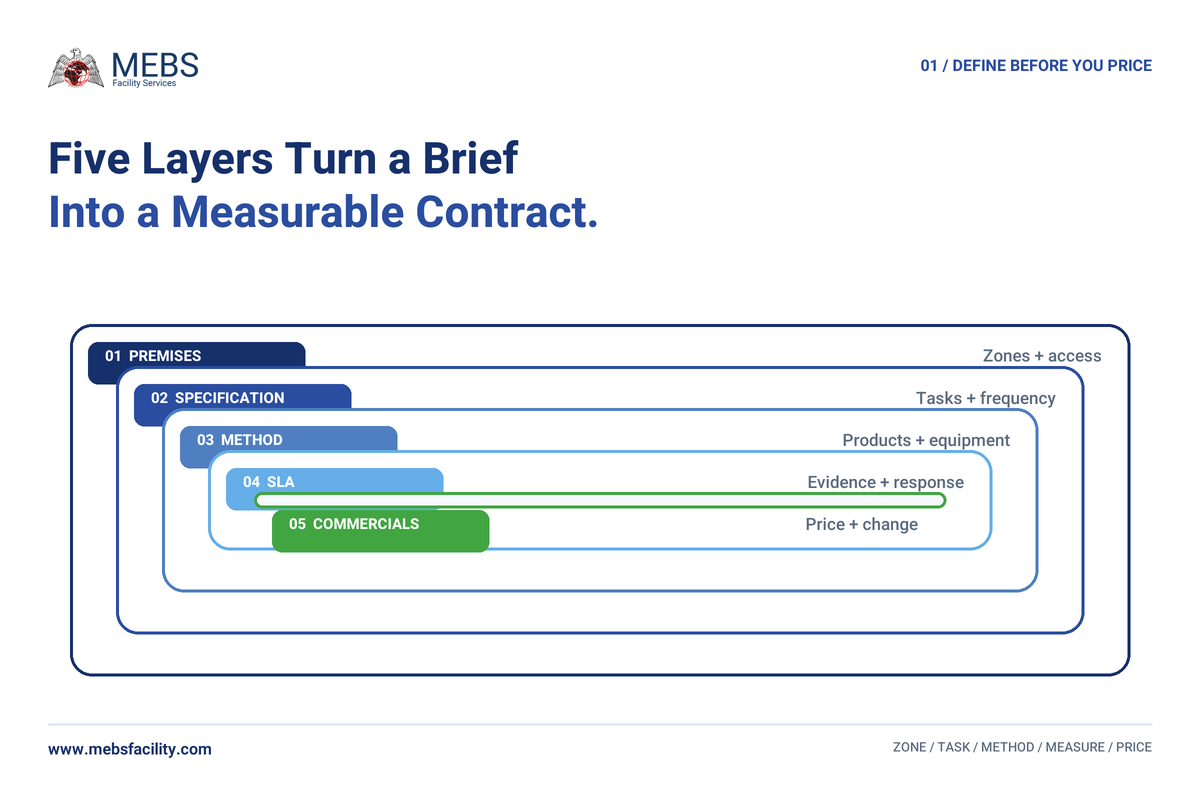
An office cleaning contract is a written agreement that links the commercial terms to a site-specific cleaning specification and service-level agreement. It should identify the premises, included zones, tasks, frequencies, hours, staffing, products, equipment, consumables, quality checks, reporting, exclusions, variation process, payment terms and responsibilities of both parties.
Three documents are often discussed as though they are the same. The contract sets the legal and commercial relationship. The cleaning specification states what work is required. The SLA defines how performance is measured, reported and corrected. A clear proposal should connect all three rather than leaving service promises in a sales email.
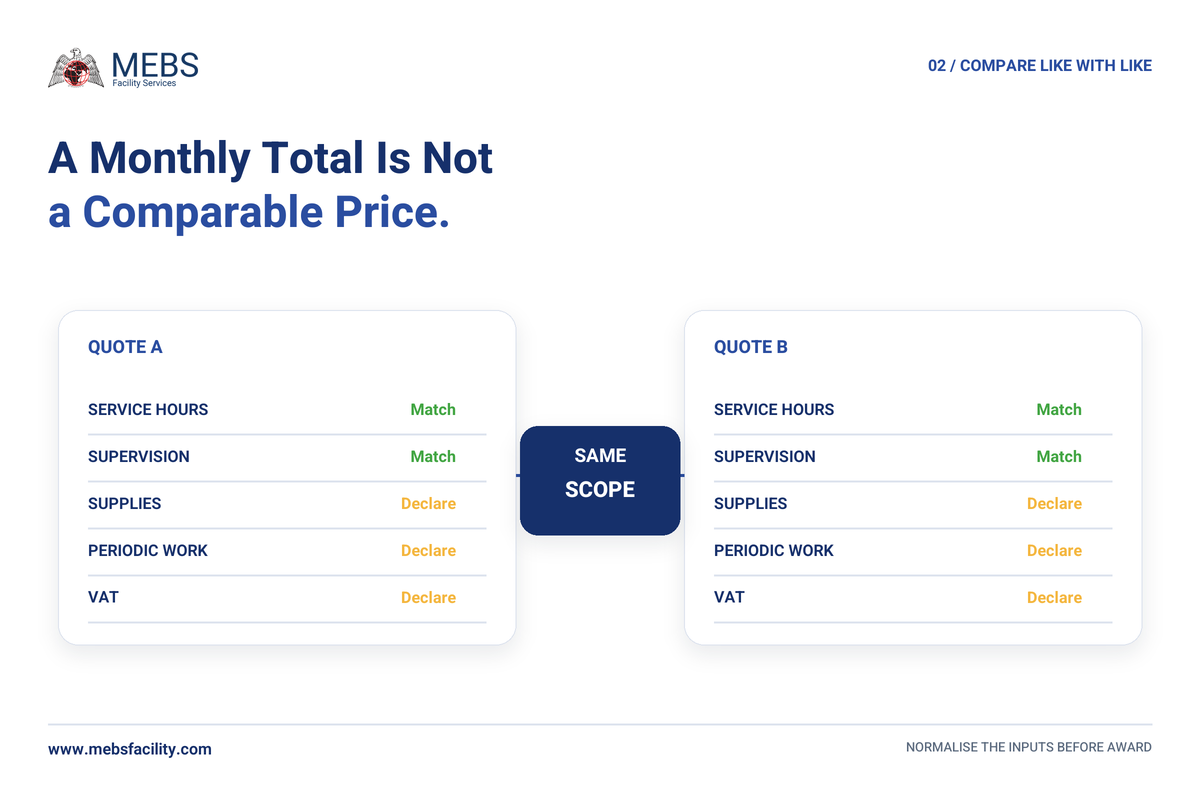
This distinction also protects the client from false comparisons. Two quotations may show similar monthly prices while one includes supervision, relief cover, chemicals and periodic floor care and the other excludes them. The contract must reveal the difference before the service begins.
What Should the Cleaning Scope Include?
The cleaning scope should list every serviced zone, the exact tasks in each zone, the required frequency, the approved method and the acceptance result. It should separately identify routine cleaning, periodic detail work, specialist services, client-supplied items and exclusions so that neither party has to guess what the monthly price covers.
For a commercial office, the zone list commonly includes reception, workstations, private offices, meeting rooms, washrooms, pantries, corridors, lift lobbies, internal glass, storage areas and accessible floors. The detailed office cleaning checklist for Dubai can be used as the task-level companion to this contract guide.
Each task should be observable. “Maintain the washroom” is vague. “Clean fixtures and mirrors, remove waste, leave floors dry and replenish contracted consumables before opening” gives the operative, supervisor and client the same target.
- Every visit or daily: waste, washrooms, pantries, traffic lanes, reception presentation, cleared work surfaces and high-touch points.
- Weekly: partitions, edges, ledges, skirting, chair vacuuming, detailed glass and rotating zone work.
- Monthly or periodic: high-level dusting, machine floor care, blinds, stores, carpet care and detailed condition reviews.
- Separate specialist scope: external façade glass, high-level access, post-construction residue, restoration, pest control and internal HVAC cleaning unless expressly included.
Which Items Are Commonly Excluded or Priced Separately?
Common exclusions include external windows, high-level access, carpet extraction, upholstery treatment, floor restoration, post-construction residue, hazardous spills, pest control, AC duct cleaning, waste beyond ordinary office volumes and consumable replenishment. Each item may be included, optional or client-supplied, but its status must be explicit in the proposal.
Ambiguity around supplies is a frequent source of scope creep. The agreement should say who purchases soap, tissue, bin liners, air fresheners and pantry items, who stores them and how usage is approved. Chemicals and cleaning equipment should be treated separately from consumables because their pricing and control are different.
Restricted rooms also need rules. Server rooms, archives, executive areas and spaces containing confidential documents may require an escort, limited access or a clean-desk condition. Cleaning staff should never be expected to move sensitive material without written authority.
Routine cleaning cannot replace specialist resets. After a fit-out or major refurbishment, use a defined post-construction cleaning scope in Dubai before the recurring office contract starts.
What Should an Office Cleaning SLA Measure?
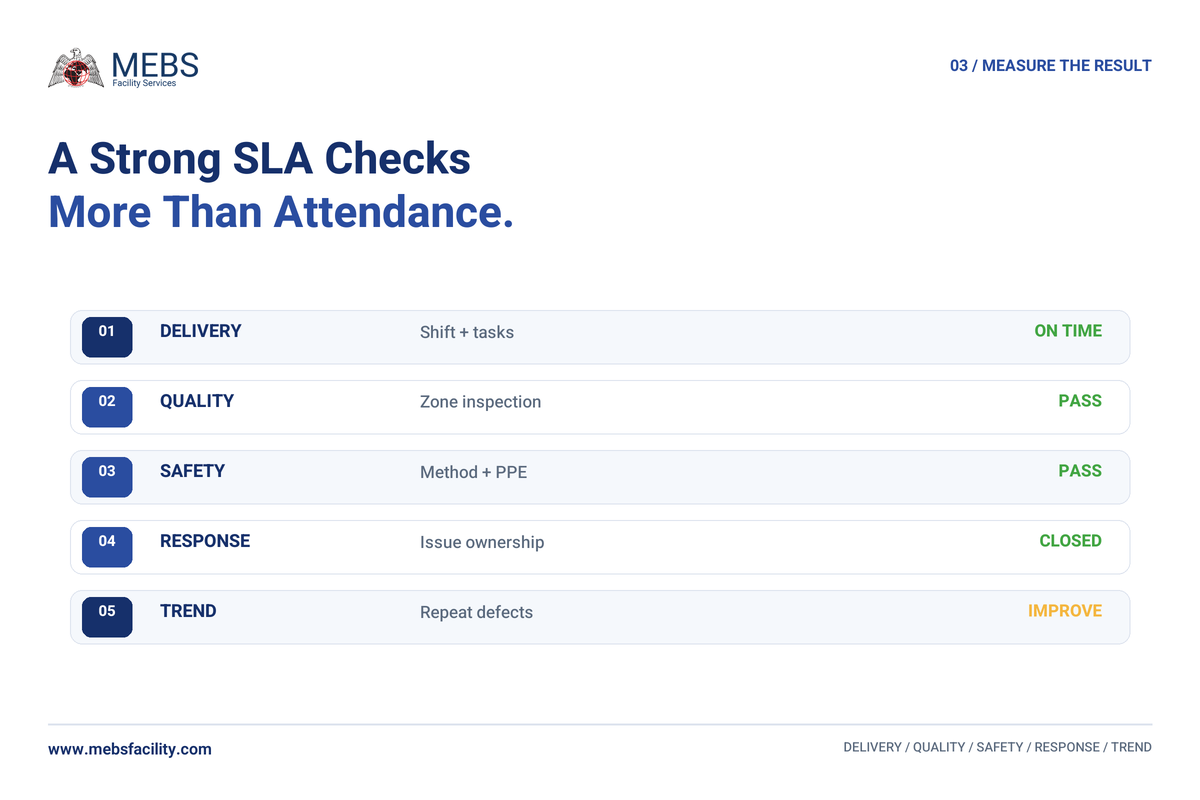
An office cleaning SLA should measure service delivery, visible quality, hygiene controls, safety, issue response and corrective-action closure. Useful measures include attendance, completion of scheduled tasks, priority-zone inspection results, consumable availability, response time for reported defects, repeat-failure rate and verification that corrective work was completed.
Attendance alone is not a quality measure. A cleaner can arrive on time while washrooms remain below standard or meeting rooms are not reset. The SLA should therefore combine delivery evidence with observable results and separate critical failures from minor presentation defects.
Use specific acceptance language. “Good condition” invites debate. “No visible debris, mirrors free of streaks, bins emptied, floors dry and dispensers stocked” is easier to inspect. Critical safety or hygiene items can use pass or fail status even when the overall score is expressed as a percentage.
| SLA Area | Evidence to Review | Example Management Question | Corrective Control |
|---|---|---|---|
| Service delivery | Attendance, shift record and task completion | Was the agreed service delivered in the agreed window? | Relief cover and missed-service recovery |
| Visible quality | Zone inspection and defect photographs | Did each priority area meet its acceptance standard? | Re-clean, supervisor check and cause review |
| Hygiene and safety | Tool separation, labels, PPE and wet-floor controls | Was the work completed using the approved method? | Stop work, retrain and verify before restart |
| Issue response | Ticket time, owner, action and closure time | Was the problem acknowledged and corrected within the agreed period? | Escalation path and named backup owner |
| Recurring performance | Repeat defects by zone and monthly trend | Is the same problem returning after correction? | Change frequency, resources, method or scope |
How Should Quality Inspections and Reporting Work?
Quality inspections should use the same zones and standards written into the cleaning specification. The operative records completion, the supervisor checks priority areas, the client representative reviews trends and both parties track unresolved defects. Reports should identify the location, condition, action, owner, deadline and verified closure instead of presenting attendance alone.
Daily sign-off is useful for operational control, but management reporting should focus on patterns. Repeated washroom defects may indicate insufficient daytime rounds. Recurring carpet edges may point to an incomplete weekly route. Frequent consumable shortages may reveal an approval or stock-control problem rather than poor cleaning.
A scorecard should preserve severity. One serious chemical, access or wet-floor failure should not disappear inside a high average. Use critical pass or fail checks beside the broader quality score, and document how repeated minor defects trigger a root-cause review.
MEBS uses supervised delivery and post-cleaning inspection as part of its published office-cleaning approach. The final reporting format should still be adapted to the property, operating hours and client governance process.
Build a Contract Around Your Dubai Office
MEBS can survey your workplace and prepare a cleaning scope based on zones, operating hours, finishes and measurable quality expectations.
Request an Office SurveyHow Are Office Cleaning Contracts Priced in Dubai?
Office cleaning contracts in Dubai are usually priced after assessing floor area, occupancy, service frequency, shift timing, labour hours, supervision, finishes, equipment, chemicals, consumables and specialist work. Published hourly or monthly offers are useful reference points, but they cannot replace a site survey or a like-for-like scope comparison.
Publicly listed Dubai offers reviewed in October 2026 showed examples around AED 25 to AED 45 per cleaner-hour, contracts starting near AED 2,000 per month, and some small-office examples around AED 2,000 to AED 3,000 per month. These figures came from a public Dubai provider price page, not an official tariff, a market guarantee or an MEBS quotation.
A lower price can reflect fewer visits, shorter shifts, limited supervision, client-supplied equipment or excluded consumables. A higher proposal may include relief cover, machines, chemicals, audit reporting and periodic work. Normalize each quotation into the same zones, frequencies, hours and inclusions before comparing totals.
The Federal Tax Authority states that VAT generally applies at 5% to taxable goods and services unless an exemption or zero rate applies. Ask whether a commercial cleaning quotation is inclusive or exclusive of VAT and confirm the treatment on the supplier's tax invoice.
For a deeper breakdown of cost drivers, review the MEBS office cleaning cost guide for Dubai. Request a tailored quotation for the actual workplace rather than applying an advertised small-office price to a larger or higher-risk property.
Which Pricing Model Is Best for an Office?
A fixed monthly price works well when zones, frequencies, service windows and change rules are stable. Hourly pricing may suit limited or variable work, while unit rates can clarify periodic services such as carpet extraction or floor treatment. The best model is the one that makes scope, assumptions and variations transparent.
Fixed pricing should not mean an undefined outcome. The provider still needs a task schedule, staffing plan and quality system. Hourly pricing should not mean unlimited flexibility. The contract should state minimum hours, what the team can reasonably complete, and how additional requests are approved.
For larger offices, separate recurring service from condition-based work. Daily cleaning can sit under the monthly fee, while specialist floor restoration or post-event recovery uses agreed unit rates or a separate quotation. This keeps the core price comparable without pretending every future requirement is known.
- Fixed monthly: predictable budget for a stable recurring specification.
- Hourly or shift-based: transparent time allocation for smaller or variable requirements.
- Unit rate: useful for measurable periodic work such as square metres of carpet or individual chairs.
- Call-off quotation: suitable for specialist or unusual work that requires a separate survey and method.
How Should a Business Compare Cleaning Quotations?
Compare cleaning quotations by applying one common scope and one scoring method to every provider. Review service fit, quality controls, safety, staffing resilience, reporting, exclusions and total evaluated cost. A bid that omits essential work should not score as cheaper simply because the missing work will be charged later.
Start with a site survey and issue the same zone list, task frequencies, service windows and consumption assumptions to shortlisted providers. Ask each company to mark inclusions, exclusions and alternatives directly against that document. This reduces the chance that one proposal prices daily washrooms while another assumes alternate days.
Then score evidence, not promises. Request a sample inspection form, escalation path, relief-cover method, mobilisation plan and example of how recurring defects are reviewed. Confirm the service aligns with a commercial environment and not a residential maid-service model.
- Map the site. Record zones, finishes, occupancy, access restrictions, visitor peaks and sensitive areas.
- Issue one scope. Give every bidder the same tasks, frequencies, service windows and exclusions.
- Normalize the price. Separate labour, supervision, equipment, chemicals, consumables, periodic work and VAT.
- Test the SLA. Check inspection standards, response times, escalation, reporting and repeat-failure controls.
- Verify delivery resilience. Review supervision, relief cover, training, mobilisation and access management.
- Document the award. Attach the agreed scope and SLA to the signed contract and keep a controlled variation process.
What Contract Clauses Reduce Operational Risk?
Operationally important clauses cover premises access, keys and cards, confidentiality, chemical and equipment control, health and safety, incident reporting, damage notification, insurance evidence, subcontracting, service changes, payment, renewal, termination and handover. High-value or unusual legal terms should be reviewed by qualified UAE counsel before signature.
After-hours access deserves particular attention. State who authorizes cleaners, where keys or cards are controlled, which rooms are restricted, who receives alarms and who confirms lock-up. A cleaning team should never rely on informal shared credentials or undocumented verbal permission.
Chemical controls should reference product labels, Safety Data Sheets and the site risk assessment. Dubai Municipality's technical guidance for cleaning and disinfection in built environments reinforces trained personnel, suitable products, personal protective equipment and controlled procedures for the situations it covers.
The variation clause should prevent silent scope growth. Changes in headcount, operating hours, floor area, pantry use or consumable supply can alter the required labour and price. Require written approval that identifies the new task, frequency, effective date and commercial effect.
Exit provisions should protect continuity. Define notice, final service, return of keys and property, removal of supplies, transfer of open issues and access cancellation. The goal is an orderly handover, not a gap between providers.
How Should Mobilisation and the First 30 Days Be Managed?
Mobilisation should translate the signed documents into people, access, tools, stock, schedules and reporting before the first service. The first 30 days should validate assumptions through inspections and issue trends, then adjust the controlled scope where occupancy, timing or material condition differs from the original survey.
Before launch, confirm the team roster, supervisor, service windows, uniforms and identification, induction, emergency contacts, key control, waste routes, storage, chemicals, Safety Data Sheets, equipment and consumable stock. Photograph or record pre-existing damage where appropriate so later responsibility is clear.
Use a joint opening inspection to establish the baseline. A contract should not treat old stains, damaged flooring or inaccessible high-level dust as a new provider failure unless restoration was included. Record what will be corrected, accepted or separately quoted.
During the first month, review defects weekly rather than waiting for a month-end score. Early data can reveal unrealistic frequencies, access delays or missing equipment. Amend the controlled schedule only with client approval, then use the new version for future audits.
Which Red Flags Should Procurement Teams Avoid?
Red flags include a price without a site survey, a scope that says only “general cleaning,” no written exclusions, no supervisor or relief-cover plan, unclear supply responsibility, attendance used as the only KPI, verbal promises outside the contract, unexplained subcontracting and renewal or termination terms that the buyer has not reviewed.
Be cautious when a proposal promises every specialist service inside one low monthly figure. Ask how much labour has been allocated, which machines are included and how periodic tasks fit the schedule. An under-resourced contract often creates repeated misses, rushed work and variation claims.
Another warning sign is a generic SLA copied across unrelated buildings. A small appointment office, a busy coworking floor and a client-facing corporate headquarters do not have the same washroom demand, visitor pattern or presentation risk. The measures should reflect the actual property.
- No task-by-zone specification attached to the price.
- No named process for complaints, corrective work and closure.
- No explanation of absence cover or supervisor availability.
- No clarity on chemicals, equipment, consumables or storage.
- No distinction between routine cleaning and commercial deep cleaning in Dubai.
- No controlled method for approving additional work.
How Can a Contract Improve Over Time?
A cleaning contract improves when inspection trends, complaints, occupancy changes and asset condition lead to controlled adjustments. Monthly reviews should identify repeat defects, over-serviced zones, under-serviced periods, consumable variance and upcoming specialist work, then assign actions with owners and deadlines instead of merely restating the score.
Review the contract after layout changes, headcount growth, new shifts, fit-outs, events or changes in building access. A schedule that worked at launch may become inefficient when a floor becomes busier or a meeting suite begins hosting external visitors every day.
Use information from related services carefully. If carpets, upholstery or floors require restoration, coordinate a planned commercial deep cleaning service. If dust or odour points to a technical HVAC issue, do not expand the cleaner's scope informally. Refer the condition to the responsible building team.
The contract review should also verify that reports remain useful. Remove paperwork that nobody reads, but preserve evidence needed to manage performance. A short exception report with ownership can be more valuable than dozens of unchecked task boxes.
Why Choose MEBS for Office Cleaning in Dubai?
MEBS provides office cleaning in Dubai through site-specific planning, trained personnel, flexible service windows, appropriate tools, supervised delivery and post-cleaning inspection. Published capabilities include workstations, common areas, washrooms, pantries, floors, carpets, interior glass and planned deep cleaning, with the final contract tailored after assessment.
The first step is understanding how the office works. Headcount, operating hours, visitor traffic, finishes, restricted rooms, waste routes and presentation priorities all shape the service. That information becomes a practical cleaning scope and inspection plan rather than a generic labour-only quotation.
MEBS has served Dubai facilities since 2000 and operates from Business Bay. The wider commercial cleaning services in Dubai support offices and other business environments, while the office-cleaning page remains the primary service for recurring corporate workplace needs.
For procurement teams, the objective is clarity before mobilisation and evidence after it. Talk to the MEBS Dubai team to arrange a site survey and receive a scope-based commercial quotation.
Turn Your Cleaning Brief Into a Measurable Service
Request a Dubai office survey and compare a tailored MEBS scope, SLA and quotation against your operational priorities.
Request a Tailored QuoteWhat Are the Most Common Office Cleaning Contract Questions?
What Should an Office Cleaning Contract Include?
It should include premises, zones, tasks, frequencies, hours, staffing, supervision, supplies, equipment, consumables, exclusions, quality checks, response times, reporting, pricing, changes, renewal and exit terms.
How Much Does an Office Cleaning Contract Cost in Dubai?
Cost depends on area, occupancy, frequency, shift timing, labour, supervision, equipment, consumables and specialist work. Published examples vary widely, so use a site survey and like-for-like scope.
What Is the Difference Between a Scope and an SLA?
The scope lists areas, tasks, frequencies and methods. The SLA explains how performance is inspected, reported, corrected and escalated when the agreed standard is missed.
Should Consumables Be Included in the Monthly Price?
They can be included, optional or client-supplied. The contract should identify each item, approval method, stock responsibility and whether usage beyond an agreed allowance changes the price.
How Often Should Cleaning Quality Be Inspected?
Priority zones should be checked after service, with recurring trends reviewed weekly or monthly. The frequency should reflect risk, complaints and the governance agreed for the property.
Can Office Cleaning Be Scheduled After Business Hours?
Yes. Define service windows, access authorization, keys, restricted rooms, emergency contacts, alarm responsibilities and lock-up procedures before after-hours cleaning begins.
What Happens When a Cleaning Standard Is Missed?
The SLA should require reporting, corrective cleaning, supervisor verification and escalation. Repeated failures should trigger a root-cause review and an agreed preventive action.
Is Deep Cleaning Included in a Regular Office Contract?
Only if it is written into the scope. Carpet extraction, upholstery care, floor restoration and high-level work may use separate frequencies, unit rates or quotations.
How Can Procurement Compare Cleaning Companies Fairly?
Give every bidder the same zones, tasks, frequencies and assumptions. Normalize labour, supervision, supplies, periodic work, exclusions and VAT before scoring quality and total cost.
Does MEBS Provide Office Cleaning Contracts Across Dubai?
Yes. MEBS provides commercial office cleaning for Dubai workplaces, with the final service scope, schedule, SLA and quotation developed after assessing the property.