



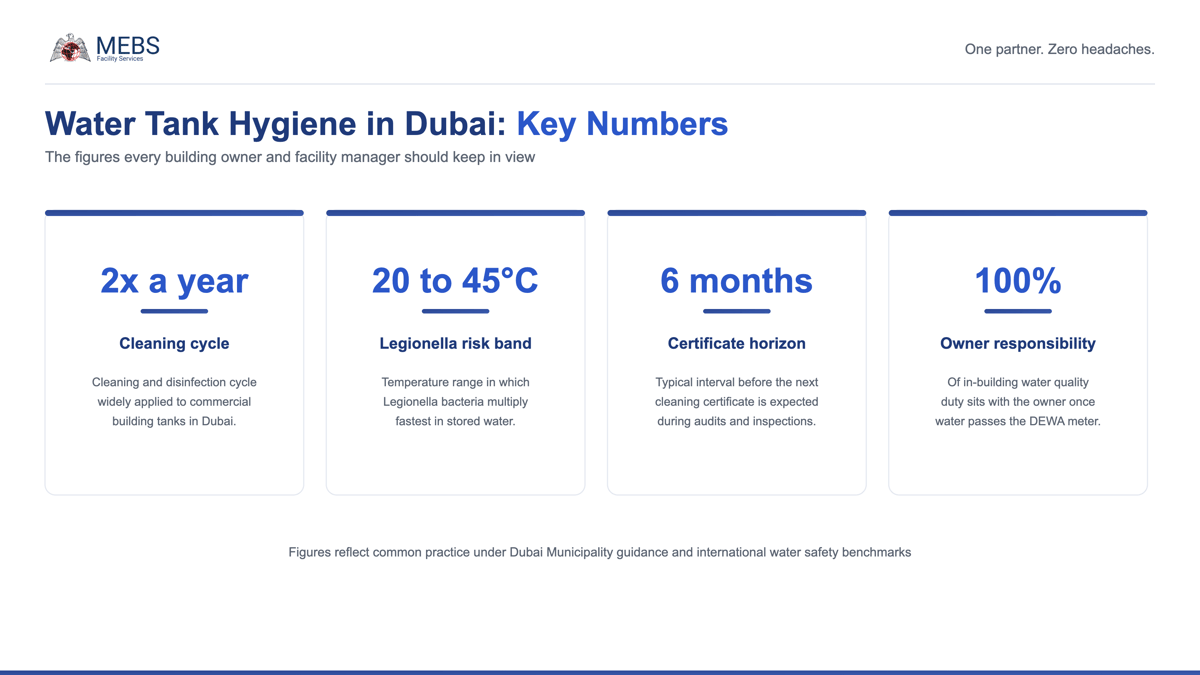
Water tank cleaning in Dubai is the scheduled draining, scrubbing, disinfection and refilling of a building's potable water tanks, followed by laboratory testing and certification. Dubai Municipality registers the companies allowed to do the work, and most commercial buildings clean their tanks twice a year.
Every glass of water your tenants drink, every shower they take and every kitchen tap they open depends on one piece of infrastructure most people never see: the building's water storage tanks. In Dubai's intense heat, a neglected tank can quietly turn into a breeding ground for bacteria, sediment and biofilm long before anyone notices a change in taste or colour. This guide explains how water tank cleaning in Dubai works, which authorities regulate it, how often it should happen and how professional cleaning protects your building from Legionella and compliance risk.
Why Water Tank Cleaning in Dubai Matters More Than in Cooler Climates
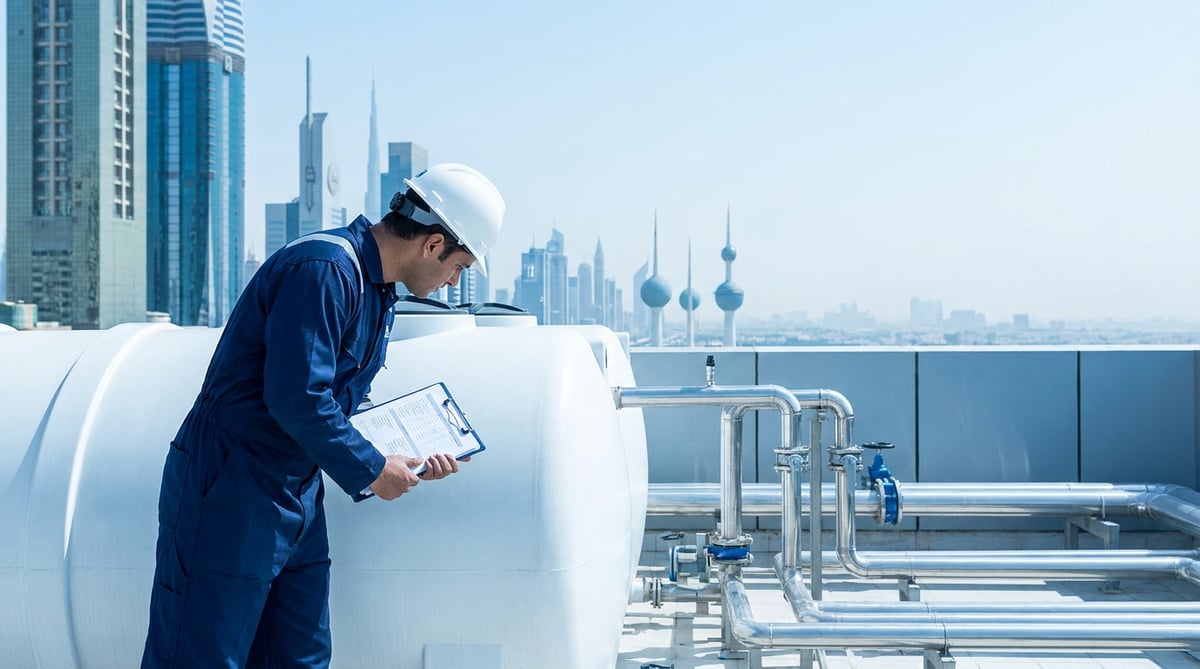
Dubai's climate makes stored water unusually vulnerable to bacterial growth, so tanks here need more frequent professional attention than tanks in temperate countries. Heat, continuous storage and high building occupancy combine to accelerate contamination.
Rooftop heat is relentless. For much of the year, roof surfaces in Dubai absorb extreme solar radiation and ambient temperatures regularly exceed 40 degrees Celsius in summer. Water sitting in rooftop tanks warms into exactly the temperature band where microorganisms thrive. Even insulated GRP and concrete tanks gradually pick up heat when water turnover is slow, for example in buildings with seasonal occupancy.
Storage is unavoidable. Unlike cities where mains pressure feeds apartments directly, most Dubai buildings rely on ground transfer tanks and rooftop gravity tanks. That means every litre of water spends time standing still, giving sediment a chance to settle and biofilm a chance to form on tank walls, ladders and float valves.
Water quality is invisible until it fails. Like indoor air quality, water hygiene is something occupants only notice when it goes wrong. By the time tenants report odour, discolouration or skin irritation, contamination is usually well established and the reputational damage to a property has already begun.
Who Regulates Water Tank Cleaning in Dubai?
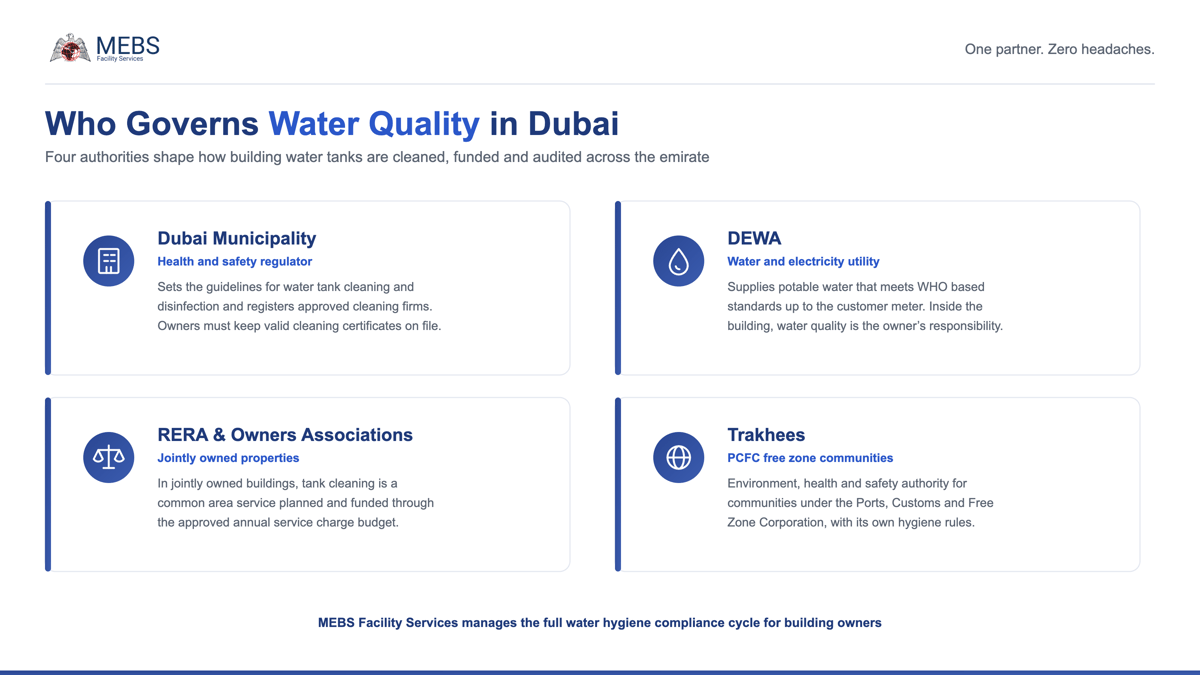
Dubai Municipality sets the technical guidelines for tank cleaning and disinfection, DEWA guarantees water quality up to the customer meter, and RERA governed owners associations fund the work in jointly owned buildings. In PCFC free zone communities, Trakhees applies its own environment, health and safety requirements.
Dubai Municipality requirements. Under Dubai Municipality guidance, water storage tanks should be cleaned and disinfected periodically by an approved specialist company, with twice yearly cleaning the widely applied benchmark for commercial buildings. The Municipality registers and audits water tank cleaning companies, and its inspectors can ask hotels, food establishments, labour accommodations and other commercial premises to produce valid cleaning certificates during routine visits.
DEWA and the meter boundary. DEWA supplies potable water that complies with WHO based standards across its network, but its responsibility ends at the customer meter. From that point onward, the building owner carries full responsibility for water quality, which is why tank hygiene sits squarely inside the facility management scope rather than the utility's.
RERA and owners associations. In jointly owned properties, tank cleaning is a common area service. Owners associations and their appointed management companies budget for it through the annual service charge plan, and RERA's oversight of those budgets means the service must be documented and defensible.
Trakhees communities. Buildings in areas regulated by the Ports, Customs and Free Zone Corporation follow Trakhees EHS requirements, which mirror Dubai Municipality expectations on water hygiene, approved contractors and record keeping.
Understanding the Legionella Risk in Building Water Systems
Legionella is a waterborne bacterium that multiplies fastest in water between roughly 20 and 45 degrees Celsius and spreads through fine water droplets from showers, taps and cooling systems. Inhaling contaminated aerosols can cause Legionnaires' disease, a serious form of pneumonia.
How exposure happens. People are not infected by drinking contaminated water but by breathing it in as a mist. Showers, spray taps, jacuzzis, decorative fountains and poorly maintained cooling towers are the classic sources. That makes hotels, residential towers, gyms and hospitals the highest risk building types in the emirate.
Why Dubai buildings are exposed. For a large part of the year, even the cold water lines in a Dubai building carry water inside the Legionella growth band. Dead legs in pipework, low occupancy apartments where outlets sit unused, and sediment at the bottom of tanks all give the bacteria nutrients and shelter. Cooling systems add a second front: condenser water and cooling towers need their own treatment regime, which is one more reason HVAC maintenance in Dubai and water hygiene programmes should be planned together.
How professional cleaning breaks the cycle. Regular tank cleaning removes the sediment and biofilm that feed bacterial colonies, while chlorination knocks down any population that has started to establish itself. Combined with temperature monitoring, flushing of low use outlets and periodic sampling, it forms the backbone of a practical Legionella control plan for any Dubai property.
What Is the Difference Between Tank Cleaning and Water Testing?
Cleaning and testing are two halves of the same duty, and a building that does one without the other has a gap it usually cannot see.
Cleaning removes the cause. Draining, scrubbing and disinfecting the tank strips out the sediment and biofilm that feed bacterial colonies. It is a physical intervention, and its effect is immediate but temporary: the moment the tank is back in service, the clock starts again.
Testing proves the result. Laboratory analysis of post-clean samples confirms that residual chlorine has fallen back to safe drinking water levels and that the water leaving the tank meets potable standards. Without it, a building has a clean tank and no evidence, which is worth very little to an inspector or an insurer.
Between cleans, testing is the early warning. Periodic sampling, temperature checks and flushing of low-use outlets catch a developing problem months before it reaches a tap. For hotels, clinics and gyms, where aerosol exposure is highest, that early warning is the difference between a scheduled correction and an incident report.
The Water Tank Cleaning Process Step by Step
A professional water tank clean follows five controlled stages: isolate and drain, clean and de-sludge, disinfect, rinse and refill, then test and certify. The entire cycle is documented so the building has evidence of compliance.
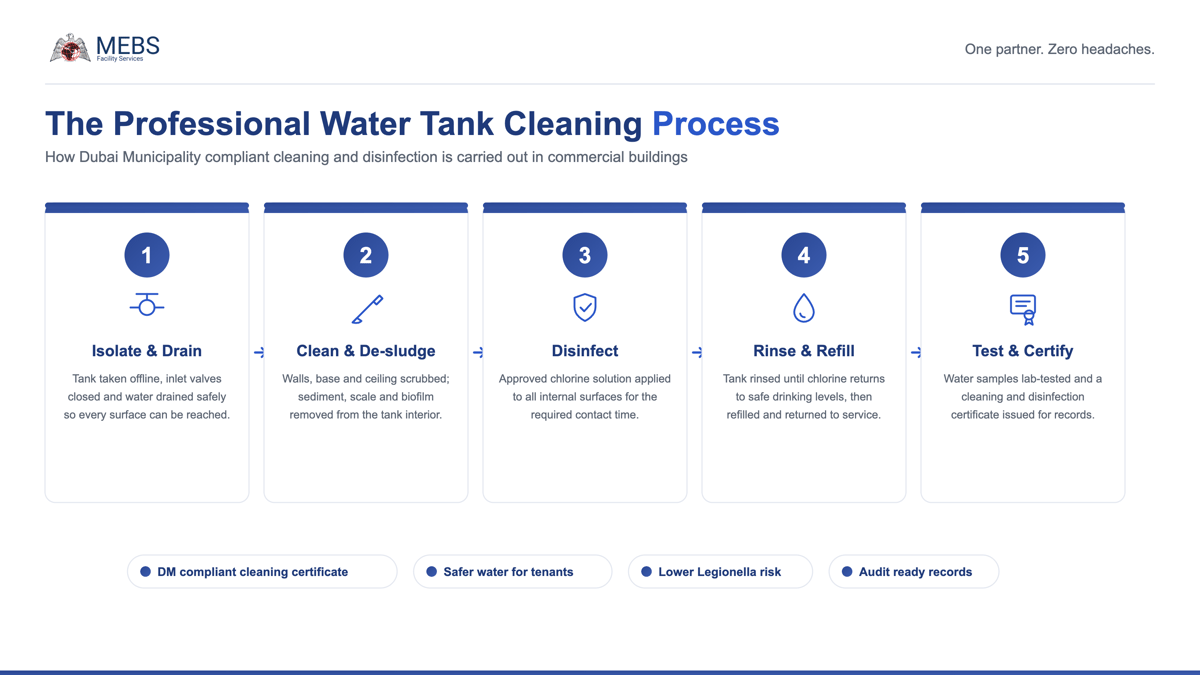
Before work starts. A competent contractor surveys the tanks, checks access hatches and ladders, plans water supply continuity and notifies occupants. Confined space entry rules apply inside most tanks, so trained technicians, gas testing and a standby person are part of the method statement, not optional extras.
During the clean. Technicians drain the tank, physically scrub walls, base, ceiling and fittings, and remove all sludge and debris. A food grade chlorine solution is then applied to every internal surface and left for the required contact time before the tank is rinsed until residual chlorine returns to safe drinking water levels.
After completion. The tank is refilled and returned to service, water samples are sent for laboratory analysis, and the company issues a cleaning and disinfection certificate. Well run buildings file these certificates with photographic before and after evidence, ready for any inspection or due diligence exercise.
How Do You Prepare a Building for Tank Cleaning?
Preparation decides whether a tank clean is a routine overnight job or a day of complaints. A competent contractor surveys the tanks, confirms how the building will stay in supply, and notifies occupants before a single valve is touched.
Survey the tanks and the access route. The contractor checks tank material, capacity, hatch condition, ladder safety and the state of float valves and pipework. Corroded hatches, missing insect screens and damaged vent covers are common findings, and they are cheaper to correct while the tank is already open and drained.
Plan supply continuity. Most Dubai buildings have either a split tank or a ground and rooftop pair, which lets technicians isolate one compartment while the other keeps feeding the building. Where a single tank serves the property, the work moves to minimum demand hours and residents are told in advance exactly when supply pauses and returns.
Treat the tank as a confined space. Entering a storage tank is a confined space operation. Trained technicians, atmospheric gas testing, a standby person outside the hatch and a written method statement are part of the job, not optional extras a contractor can quietly drop to win on price.
Tell occupants what is happening. A short notice explaining the date, the expected interruption and the reason for it prevents the calls that otherwise follow discoloured water after refill. Buildings that communicate well see tank cleaning as a trust-building exercise rather than a disruption.
How Often Should Water Tank Cleaning in Dubai Be Done?
Twice a year is the standard cleaning frequency applied to commercial building tanks in Dubai, with quarterly inspections in between for higher risk facilities. The right schedule depends on tank condition, occupancy and the building's use.
| Building Type | Cleaning Frequency | Typical Additional Checks |
|---|---|---|
| Commercial offices and retail | Twice a year | Annual water sampling, visual inspection between cleans |
| Hotels, gyms and spas | Twice a year minimum | Quarterly inspections, monthly temperature checks, aerosol outlet flushing |
| Hospitals and clinics | Twice a year minimum | Quarterly inspections and more frequent sampling |
| Food and beverage premises | Twice a year minimum | Certificates checked at Municipality inspections |
| Residential towers | Twice a year | Flushing of low-use apartment outlets, owners association records |
| Villas with private tanks | Twice a year | Post-summer clean strongly recommended |
Higher risk facilities need tighter cycles. Hotels, hospitals, clinics, schools, gyms and food and beverage operations face stricter scrutiny because their occupants are more vulnerable or their water use creates more aerosols. For these buildings, six monthly cleaning is a minimum and many operators add quarterly visual inspections and monthly temperature checks.
Planned beats reactive every time. Emergency tank cleaning after a failed inspection or a tenant complaint costs more, disrupts the building and leaves a paper trail no owner wants. As we explained in our guide to preventive versus reactive maintenance, scheduled servicing is consistently cheaper than crisis response, and water hygiene is the clearest example of that rule.
Watch for the warning signs. Discoloured water, unusual taste or smell, visible sediment when taps first open, recurring pump strainer blockages and tenant complaints about skin or eye irritation all suggest the tank needs attention before the next scheduled visit.

What Happens If You Skip Water Tank Cleaning?
Skipping scheduled tank cleaning does not usually cause a dramatic failure. It causes a slow accumulation of sediment, biofilm and risk that surfaces at the worst possible moment, normally an inspection or a tenant health complaint.
Enforcement exposure comes first. Dubai Municipality inspectors can ask hotels, food establishments, labour accommodations and other commercial premises to produce valid cleaning certificates during routine visits. An owner who cannot produce records is exposed to enforcement action regardless of whether the water itself later tests clean.
Liability follows the certificate trail. If an occupant falls ill and the building cannot show a documented cleaning and testing history, the owner and the owners association carry that gap. Insurers and prospective buyers examine the same file during claims and due diligence, and an incomplete record weakens both positions.
The cost curve moves the wrong way. Emergency cleaning after a failed inspection or a complaint costs more than a planned visit, disrupts the building at short notice, and leaves a paper trail no owner wants attached to the asset. As our guide to preventive versus reactive maintenance sets out, scheduled servicing is consistently the cheaper path, and water hygiene is the clearest example of that rule.
Choosing a Water Tank Cleaning Partner in Dubai
The right partner is a company registered with Dubai Municipality for water tank cleaning, staffed by trained technicians, and able to deliver testing, certification and record keeping as part of the service. Integration with your wider maintenance programme is what separates a contractor from a partner.
Check approvals and training first. Ask for the company's Dubai Municipality registration, technician training records and confined space procedures. A firm that hesitates on any of these three is a risk you do not need, whatever the price advantage.
Look for integrated delivery. Tank cleaning touches plumbing, pumps, water treatment and housekeeping. Buildings that bundle it into an annual maintenance contract or a wider outsourced facility management agreement keep the cleaning schedule, the pump and plumbing work and the certificate trail moving together, so a missed tank clean cannot quietly fall between two service visits. MEBS delivers water tank cleaning as part of our cleaning services across Dubai, from single villas to high rise portfolios, coordinated with the pump and plumbing work handled by our building maintenance team.
Demand documentation. Every visit should end with a certificate, laboratory results, photographs and an updated asset log. That file is what protects you in front of an inspector, an insurer or a prospective buyer of the property.
What Records Should You Keep After a Water Tank Clean?
The clean is only half the job. The file it produces is what protects the building in front of an inspector, an insurer or a buyer, and it should be assembled the same week the work is done.
-
The cleaning and disinfection certificate issued by the Dubai Municipality registered company, showing the date and the tanks covered
-
Laboratory analysis of post-clean water samples, confirming residual chlorine has returned to safe drinking water levels
-
Dated before and after photographs of each tank interior
-
An updated asset log recording tank condition, defects found and any parts replaced
-
The method statement and confined space records for the visit
-
The next scheduled cleaning date, diarised rather than left to memory
Buildings that keep this file current answer an inspector's questions in minutes. Buildings that do not spend days reconstructing a history that may not exist, which is precisely when a small compliance gap becomes an expensive one.
Final Thoughts on Water Tank Cleaning in Dubai
Water tank cleaning in Dubai is not an optional extra. It is a recurring compliance duty, a public health safeguard and a quiet contributor to tenant satisfaction and asset value. The rules are clear, the process is well established and the cost of doing it properly is small compared with the cost of a contamination incident or a failed inspection.
The buildings that get it right treat water hygiene as a programme rather than a purchase: scheduled cleaning, laboratory testing, temperature monitoring and disciplined record keeping, all owned by one accountable team. MEBS Facility Services runs that programme every day for property owners and managers across Dubai and the UAE, keeping tanks clean, certificates current and inspectors satisfied.