



CCTV rules in Dubai are set by SIRA, the Security Industry Regulatory Agency. Every commercial building must install a SIRA-approved CCTV system, use minimum 4K cameras, retain footage for at least 31 days, connect to SIRA's VideoGuard network, and have the system certified by a SIRA-licensed company.
Installing cameras is the easy part. Making them legal is where most Dubai businesses come unstuck. In Dubai, closed-circuit television is not a private security decision, it is a regulated obligation governed by SIRA, the Security Industry Regulatory Agency. The rules cover which premises need cameras, how those cameras must perform, how long footage is stored, and how the whole system connects back to SIRA for oversight.
This guide sets out the CCTV rules and regulations in Dubai in plain language: who must comply, the exact technical standards, the certification process step by step, the penalties for getting it wrong, and how to keep a system compliant year after year.
What Are SIRA's CCTV Rules in Dubai?
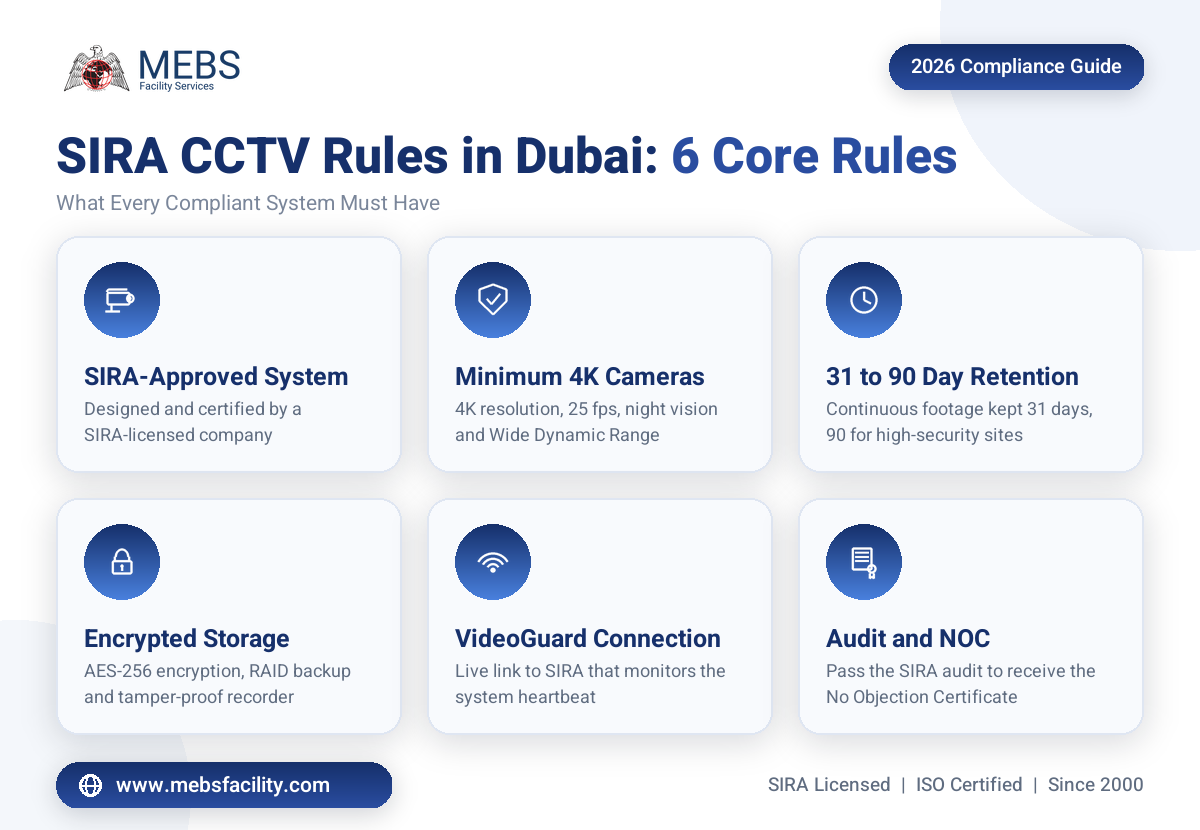
SIRA's CCTV rules are a mandatory technical and operational standard that every commercial premises in Dubai must meet before its surveillance system is considered legal. They exist so that footage is usable as evidence, available to the authorities when needed, and protected against tampering. At a high level, the rules require the following.
-
A CCTV system designed, installed and certified by a SIRA-licensed company, not a general electrician or an unlicensed installer
-
Cameras that meet SIRA's minimum resolution, frame rate and night-vision specifications
-
Footage retained for a minimum of 31 days, and up to 90 days for high-risk premises
-
Encrypted, tamper-protected recording equipment stored securely on site
-
A live connection to SIRA through an approved VideoGuard device so the system's status is monitored continuously
-
A completed audit and a No Objection Certificate (NOC) confirming the installation is compliant
Miss any one of these and the system is non-compliant, even if the cameras themselves work perfectly. That is the single most common misunderstanding among Dubai property owners: a working camera is not the same as a compliant one.
Who Must Install SIRA-Approved CCTV in Dubai?
SIRA's CCTV requirement reaches far beyond banks and jewellers. In practice, almost every premises that holds a Dubai trade licence and receives the public is expected to run a compliant system. The obligation typically applies to the following categories.
-
Retail and commercial: shops, shopping malls, offices and commercial towers
-
Hospitality: hotels, restaurants, cafes and entertainment venues
-
Industrial: factories, warehouses, plants and logistics yards
-
High-security: banks, exchange houses, jewellers and gold traders
-
Healthcare and education: hospitals, clinics, schools and nurseries
-
Residential: apartment towers and gated communities, for their shared and common areas
The practical trigger is your trade licence. Dubai Municipality, the DED and free-zone authorities increasingly cross-check SIRA compliance when a licence is issued or renewed, which means a missing or non-compliant CCTV system can quietly stall an otherwise routine renewal.
What Camera Specifications Does SIRA Require?
SIRA does not simply require "a camera". It sets minimum performance standards so that recorded footage is clear enough to identify faces, plates and actions. For 2026, the baseline specifications are as follows.
-
Resolution: minimum 4K Ultra HD (3840 x 2160), with the highest-grade cameras placed at entrances, exits and cash-handling points
-
Frame rate: at least 25 frames per second for smooth, evidential playback
-
Night vision: infrared illumination effective to around 30 metres for genuine 24/7 coverage
-
Wide Dynamic Range (WDR): to handle Dubai's harsh contrast between bright exteriors and shaded interiors
-
Weatherproof housings: external cameras rated for heat, dust and humidity
These are minimums, not targets. Premises handling cash or high-value stock are expected to exceed them, and many operators pair compliant hardware with AI-based CCTV monitoring to add analytics such as line-crossing and loitering detection on top of the baseline SIRA requirement.
How Long Must You Keep CCTV Footage in Dubai?
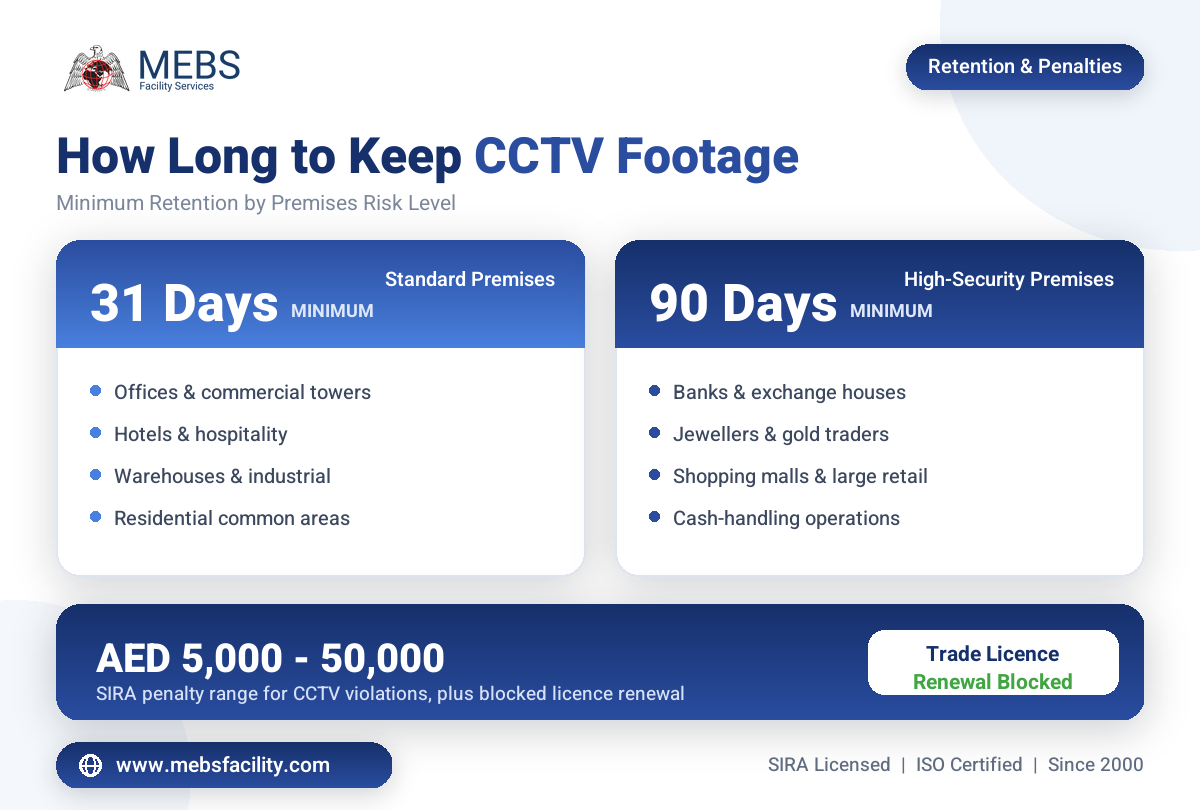
Footage retention is one of the most tightly enforced parts of the rules, because footage that has already been overwritten is useless in an investigation. The minimum retention period depends on the risk category of the premises.
-
Standard premises such as offices, hotels, retail units and residential towers must keep footage for a minimum of 31 days
-
High-security premises such as banks, jewellers, exchange houses and large shopping malls must keep footage for a minimum of 90 days
The retention clock is continuous. A system that records for 31 days but loses a week because a hard drive failed is non-compliant for that week, which is why storage reliability, not just storage size, is part of the standard.
What Are the Storage and Encryption Requirements?
SIRA treats the recorder as critical evidence infrastructure, so how footage is stored matters as much as how it is captured. Compliant storage must meet the following conditions.
-
RAID configuration so that a single disk failure does not wipe out recorded footage
-
AES-256 encryption on stored footage and on any network transmission
-
A tamper-protected network video recorder (NVR) kept in a secure, access-controlled location
-
Password protection, current firmware and closed default ports to resist cyber intrusion
-
No reliance on consumer cloud accounts or unsecured DVRs that fall outside the standard
The cybersecurity element has tightened for 2026. Because CCTV systems are network-connected, SIRA now expects encrypted connections and secured remote access, treating an exposed recorder as a compliance failure in its own right.
Where Must CCTV Cameras Be Placed?
Coverage is judged on whether the cameras capture what matters, not on how many are installed. SIRA expects meaningful coverage of every point where people, money or goods move, while respecting privacy where the law requires it.
Cameras are expected at all entry and exit points, reception and lobby areas, car parks and loading bays, lifts and stairwell entrances, cash registers and tills, and stock or storage rooms. Coverage should be continuous enough that a person cannot cross the premises without being recorded at the key transition points.
Privacy Zones Where Cameras Are Prohibited
The rules draw a firm line at spaces with a reasonable expectation of privacy. Cameras must never be installed in restrooms, changing rooms, locker rooms, prayer rooms or the private interiors of residences. Placing a camera in these areas is itself a violation, regardless of intent, and exposes the operator to both a SIRA penalty and a separate privacy complaint.
What Is SIRA VideoGuard and Why Does It Matter?
VideoGuard (also referenced as VRL) is the device that connects a building's CCTV system to SIRA's monitoring network, and it is the piece most non-specialists overlook. It is not a camera and it does not record; it supervises.
VideoGuard continuously watches the health, or "heartbeat", of the system. If a camera goes offline, recording stops, or the storage fails, an automated alert is sent to SIRA. This is why a working camera alone is not enough: without a verified VideoGuard connection, SIRA has no assurance the system is actually running. A current VideoGuard connectivity report is required to obtain a building completion certificate and, increasingly, to renew a trade licence, which ties CCTV compliance directly to a building's legal operation.
How Do You Register and Certify a CCTV System With SIRA?
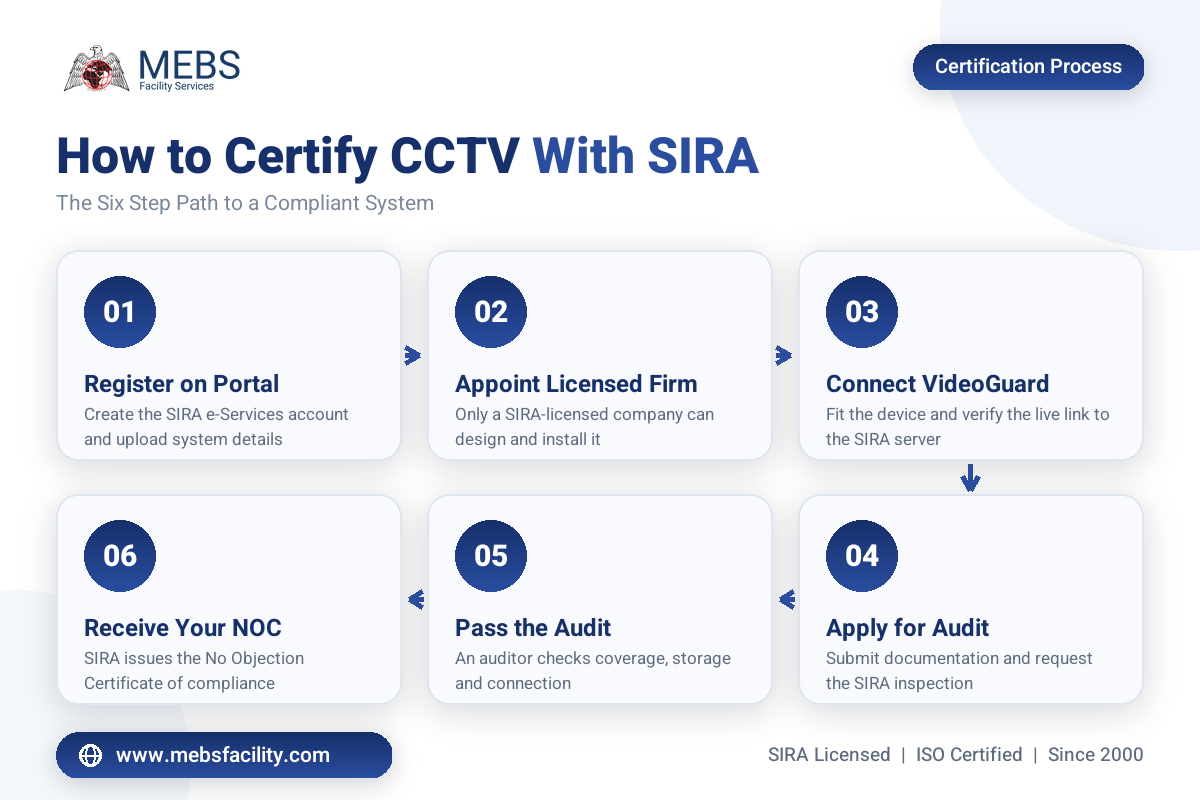
Certifying a CCTV system with SIRA follows a defined sequence. A SIRA-licensed company usually manages the process on the owner's behalf, but every property owner should understand the six stages so nothing is missed.
Step 1: Create Your SIRA Portal Account
Register the premises on the SIRA e-Services portal and upload the system details, including the site plan, camera schedule and equipment specifications. This creates the compliance record SIRA will assess against.
Step 2: Engage a SIRA-Licensed CCTV Company
Only a SIRA-licensed company may design, install and certify a compliant system. Appointing a licensed provider at the design stage prevents the costly rework that follows when an unapproved installation fails its audit.
Step 3: Install VideoGuard and Verify the Connection
The installer fits the approved VideoGuard device and confirms a live link to the SIRA server. SIRA issues a connection verification certificate once the heartbeat is confirmed.
Step 4: Apply for the Audit Inspection
With the system installed and connected, the licensed company applies for a SIRA audit through the portal, submitting the completed documentation for review.
Step 5: Pass the SIRA Audit
SIRA assigns an auditor who inspects the installation against the standard, checking camera coverage, resolution, retention, storage security and the VideoGuard connection, then issues an inspection report.
Step 6: Receive Your No Objection Certificate
Once the auditor approves the installation, SIRA issues the No Objection Certificate (NOC). The NOC is the formal proof of CCTV compliance that inspectors, insurers and licensing authorities will ask to see.

What Are the CCTV Requirements by Premises Type?
While the core standard is consistent, retention periods and coverage priorities scale with the risk profile of the premises. The table below summarises the practical requirement by property type.
| Premises Type | Minimum Retention | Key CCTV Requirement |
|---|---|---|
| Banks, jewellers & exchange houses | 90 days | Highest-grade cameras, full till and vault coverage, panic integration |
| Shopping malls & large retail | 90 days | Entrance, aisle and cash-point coverage at high resolution |
| Hotels & hospitality | 31 days | Lobby, corridor, entry and car park coverage |
| Offices & commercial towers | 31 days | Entry, exit, lift lobby and parking coverage |
| Warehouses & industrial | 31 days | Perimeter, loading bay and storage area coverage |
| Residential complexes | 31 days | Common areas, entries and parking only, no private interiors |
What Are the Penalties for CCTV Violations in Dubai?
Non-compliance is enforced, and the consequences go well beyond a single fine. SIRA penalties for CCTV violations generally fall between AED 5,000 and AED 50,000, with repeat or serious breaches attracting the higher end of the range. The fuller schedule is set out in our guide to SIRA fines and violations in Dubai.
The financial penalty is often the smallest problem. Non-compliance can also block a trade licence renewal, trigger a mandatory corrective installation order, and leave the business exposed to civil liability if an incident occurs and no usable footage exists. In practice, an inspection that finds a non-compliant system can freeze a company's licensing and tendering position until the fault is fixed and re-audited.
How Often Must a SIRA CCTV System Be Renewed and Audited?
Compliance is not a one-off event. A SIRA CCTV operator licence is typically valid for two years, after which it must be renewed, and the VideoGuard connection must remain live and verifiable throughout that period.
A current VideoGuard connectivity report is required at trade licence renewal, so a lapsed connection can hold up the wider business. Late renewal can lead to suspension of the surveillance operation, and any material change to the system, such as adding cameras or replacing the recorder, should be re-registered so the compliance record stays accurate. Keeping the system, its accreditation and compliance records and its audit history current is what turns CCTV from a recurring headache into a background certainty.
Why Hire a SIRA-Certified CCTV Partner in Dubai?
The rules reward specialists and punish improvisation. A SIRA-certified partner designs to the standard from day one, manages the portal registration, VideoGuard connection and audit, and keeps the retention, storage and renewal obligations on schedule so nothing lapses. That is the difference between a system that passes its audit first time and one that fails, gets re-worked, and delays a licence.
It is also one of the first things buyers verify when they choose a security company in Dubai. Whether you need a new compliant installation, an upgrade of an ageing system, or ongoing SIRA CCTV operator cover, working with a licensed provider keeps the cameras legal, the footage admissible and the trade licence clear. Many Dubai businesses fold CCTV into a broader managed security service so guarding, monitoring and compliance sit with one accountable partner.