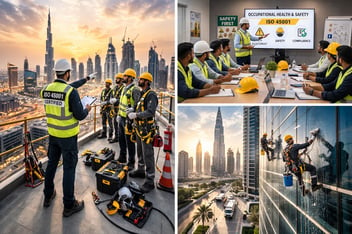




Workplace safety in Dubai has moved from a background concern to a boardroom priority. In a city defined by high-rise towers, mixed-use communities, and around-the-clock commercial activity, a single preventable incident can halt operations, trigger heavy fines, and damage a landlord's reputation for years. For property owners and facility managers, understanding how workplace safety in Dubai is regulated, and how it is delivered on the ground, is now essential to protecting both people and assets.
This guide explains the legal framework, the core requirements, the most common hazards, and the practical role that professional facility management plays in keeping Dubai buildings safe and compliant.
What Is Workplace Safety in Dubai?
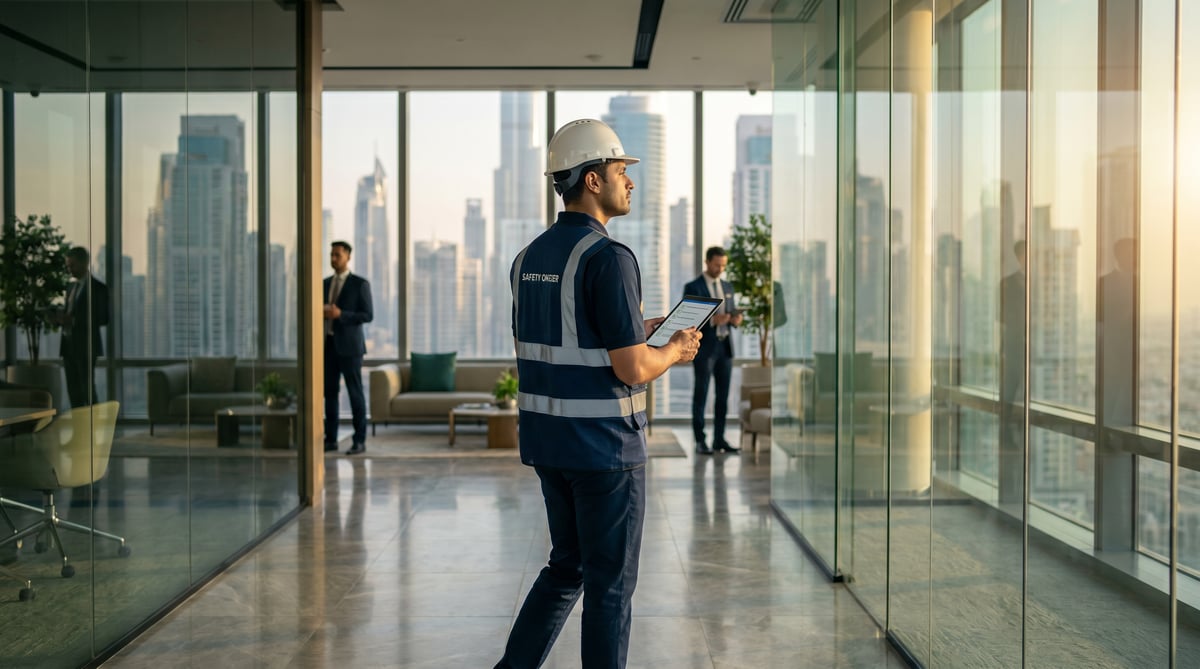
Workplace safety in Dubai refers to the policies, systems, and preventive measures that protect employees, visitors, and contractors from injury, illness, and occupational hazards inside commercial and industrial premises, in line with UAE federal law and Dubai regulations. It covers everything from fire and electrical safety to heat stress, air quality, and emergency readiness.
In practice, workplace safety is a shared responsibility between building owners, occupiers, and their service providers. Employers must provide a safe environment, and facility management partners such as MEBS Facility Services translate those legal obligations into daily inspections, maintenance routines, and trained response teams. The goal is simple: prevent incidents before they happen, rather than react after the damage is done.
The Legal Framework Governing Workplace Safety in Dubai
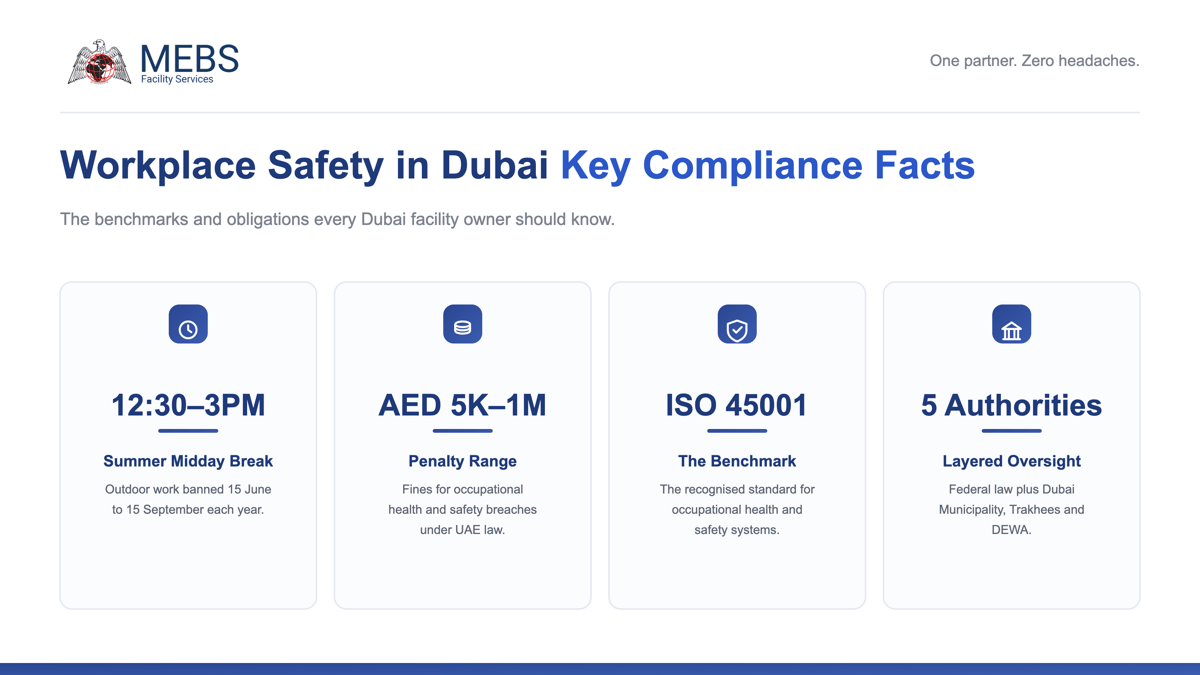
Workplace safety in Dubai is governed by a layered framework of federal laws, Cabinet resolutions, and local authority codes. Compliance is mandatory, and the responsible authority depends on where your property sits.
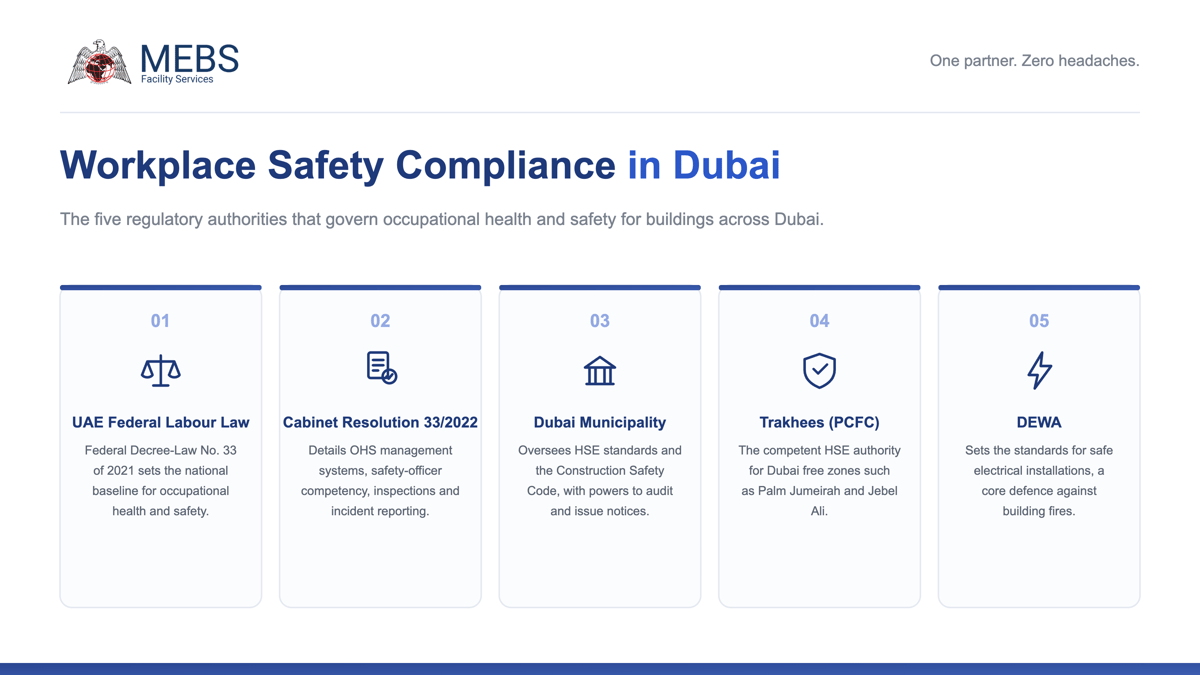
UAE Federal Labour Law. Federal Decree-Law No. 33 of 2021, which took effect in February 2022, sets the national baseline for occupational health and safety. It requires employers to protect workers from work-related risks, provide safe systems of work, and supply appropriate protective equipment at no cost to the employee.
Cabinet Resolution on Occupational Health and Safety. Cabinet Resolution No. 33 of 2022 builds on the Labour Law with detailed requirements for occupational health and safety management systems, competency standards for safety officers, inspection frequencies, and incident reporting formats. It is the practical rulebook that most Dubai employers are measured against.
Dubai Municipality. Dubai Municipality oversees health, safety, and environment standards across the emirate, including a well-established Construction Safety Code and building-related HSE requirements. Its inspectors can audit premises, issue notices, and require corrective action where standards fall short.
Trakhees. For properties inside free zones and special development areas managed by the Ports, Customs and Free Zone Corporation, Trakhees acts as the competent HSE authority. Its Environment, Health and Safety regulations, including dedicated occupational health and safety rules, apply to communities such as Palm Jumeirah, Jebel Ali, and Dubai World zones.
DEWA. The Dubai Electricity and Water Authority sets the standards for safe electrical installations and connections. Faulty wiring and overloaded systems remain a leading cause of building fires, so DEWA compliance is a central pillar of any workplace safety programme. Certifications such as ISO 45001 for occupational health and safety help facilities demonstrate that these overlapping obligations are being managed to a recognised international standard.
Core Workplace Safety Requirements Every Dubai Facility Must Meet
Every commercial building in Dubai must meet a set of baseline safety requirements covering risk, equipment, working conditions, and emergency readiness. Falling short of any one of them can expose owners to enforcement action.
Risk assessments and method statements. Employers are expected to identify hazards, assess their likelihood and severity, and document control measures before work begins. Risk assessments should be reviewed regularly and updated whenever a process, layout, or piece of equipment changes.
Personal protective equipment. Under UAE law, employers must provide suitable protective clothing and equipment free of charge and ensure it is used correctly. For facility teams this means hard hats, gloves, eye protection, and high-visibility clothing appropriate to each task.
The summer midday break. Now in its third decade, the UAE midday break bans all work under direct sunlight and in open areas between 12:30pm and 3pm, from 15 June to 15 September each year. Recent guidance has expanded heat stress management to include monitoring, acclimatisation schedules, and heat awareness training for outdoor workers.
Fire and life safety. Buildings must maintain compliant fire detection, alarm, suppression, and evacuation systems, along with clear escape routes and regular drills. Strong emergency preparedness for commercial buildings in Dubai is the difference between a controlled evacuation and a crisis.
Electrical and mechanical safety. Regular inspection and servicing of electrical panels, lifts, HVAC plant, and pressurised systems prevents the failures that injure people and start fires. This is where a disciplined preventive maintenance approach directly protects occupants.
Periodic medical examinations. Workers exposed to occupational hazards must undergo periodic health checks so that any work-related illness is identified and managed early.
Common Workplace Safety Hazards in Dubai Buildings
The most common workplace safety hazards in Dubai buildings are heat stress, falls, electrical faults, poor air quality, and fire risk. Each one is preventable with the right maintenance and monitoring.
Heat stress. With summer temperatures regularly exceeding 45 degrees Celsius, heat is the defining seasonal hazard for outdoor and semi-outdoor workers. Hydration stations, shaded rest areas, and strict adherence to the midday break are essential controls.
Slips, trips, and falls. Wet floors from cleaning or condensation, poor lighting, and cluttered service corridors cause a large share of everyday injuries. Clear signage, prompt spill response, and good housekeeping keep these risks low.
Electrical and mechanical hazards. Ageing panels, overloaded circuits, and neglected lifts or escalators pose serious risks in busy commercial towers. Planned inspection cycles catch these problems before they escalate.
Indoor air quality. In a climate where buildings are sealed and cooled for most of the year, poorly maintained ventilation can circulate dust, mould spores, and pollutants. Clean, well-serviced HVAC systems protect both comfort and health.
Fire risk. Combustible storage, blocked exits, and electrical faults remain the leading contributors to building fires. Regular fire safety checks and staff awareness are non-negotiable.
How Facility Management Strengthens Workplace Safety
Professional facility management strengthens workplace safety by converting legal requirements into structured, repeatable routines that are inspected, documented, and continuously improved. It is the operational engine behind a compliant, low-risk building.
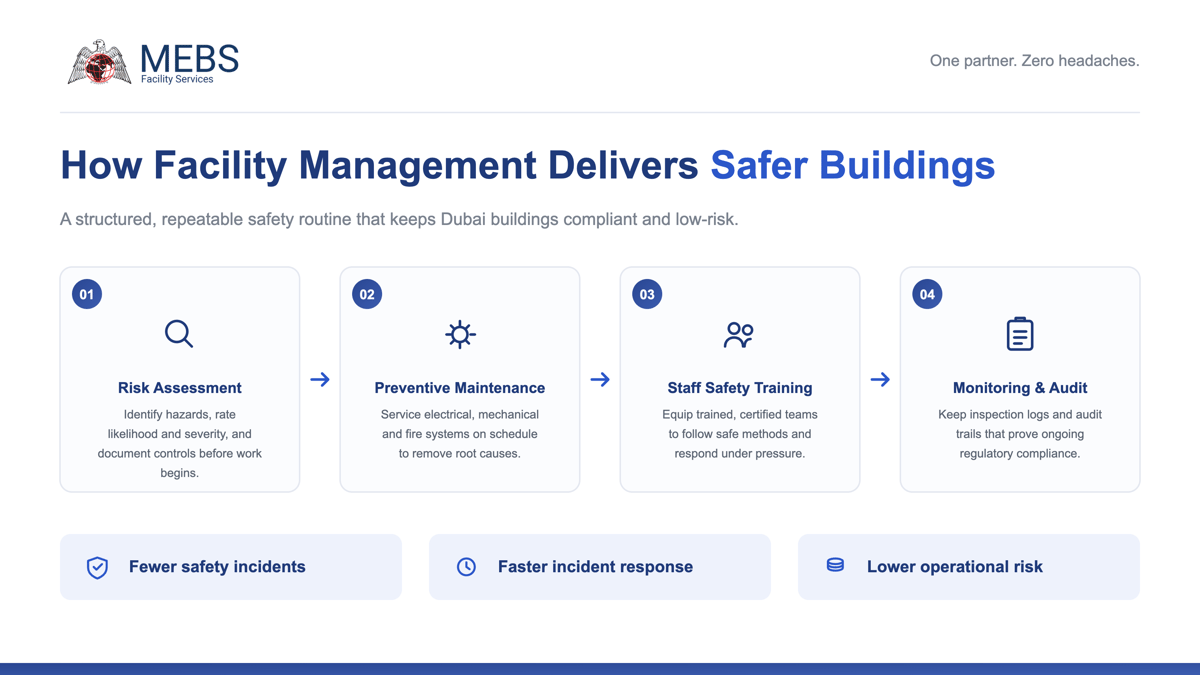
Preventive maintenance reduces failures. Scheduled servicing of electrical, mechanical, and fire systems removes the root causes of most incidents. A well-run programme means fewer breakdowns, fewer emergencies, and a safer environment for everyone on site.
Trained and certified teams. Safety depends on competent people. Providers like MEBS Facility Services invest in accredited training so technicians, cleaners, and security staff understand hazards, follow safe methods, and respond correctly under pressure.
Compliance documentation and audits. Regulators expect evidence. Facility managers maintain the risk assessments, inspection logs, permits, and audit trails that prove a building meets Dubai Municipality, Trakhees, and federal requirements. This is a core benefit of a strategic facility management approach.
Rapid incident response. When something does go wrong, trained teams and clear procedures contain the situation quickly, limiting harm and downtime. Many owners find that outsourced facility management in Dubai gives them access to this depth of expertise without building an in-house team.
The Business Case for Workplace Safety in Dubai
Beyond compliance, workplace safety in Dubai delivers a clear commercial return through avoided penalties, stronger reputation, and higher productivity. Safety is not a cost centre, it is a value driver.
Avoiding penalties. Occupational health and safety breaches under UAE federal law can carry fines ranging from AED 5,000 to as much as AED 1,000,000, alongside possible emirate-level penalties and operational suspensions. Prevention is far cheaper than enforcement.
Protecting reputation and tenant retention. Tenants and employers increasingly choose buildings that can demonstrate strong safety credentials. A visible commitment to safety supports occupancy, rental value, and long-term relationships.
Productivity and cost savings. Fewer incidents mean less downtime, lower insurance exposure, and a workforce that performs with confidence. Over a building's life cycle, disciplined safety management protects the bottom line as effectively as it protects people.
Making Workplace Safety a Priority in Dubai
Workplace safety in Dubai is a legal duty, a reputational asset, and a measure of operational excellence all at once. The buildings that thrive are those that treat safety as a continuous discipline rather than an annual inspection. By pairing clear compliance with proactive facility management, owners can protect occupants, satisfy regulators, and safeguard their investment. MEBS Facility Services helps Dubai property owners turn these obligations into dependable, everyday practice, so safety is built into the way a building runs.
Frequently Asked Questions
Who is responsible for workplace safety in Dubai?
Responsibility is shared. Under UAE federal law, the employer or building owner holds the primary legal duty to provide a safe workplace, supply protective equipment, and manage risks. In practice, this duty is delivered day to day by facility management providers who carry out inspections, maintenance, training, and emergency planning. Regulators such as Dubai Municipality and Trakhees enforce compliance and can audit premises, issue notices, and impose penalties where standards are not met.
What is the midday break rule in Dubai?
The midday break is a national UAE rule that prohibits work under direct sunlight and in open-air areas between 12:30pm and 3pm, from 15 June to 15 September every year. It is designed to protect outdoor workers from extreme summer heat. Employers must also provide shaded rest areas, drinking water, and heat stress awareness, and recent guidance has widened these requirements to include monitoring and acclimatisation for workers exposed to high temperatures.
Is ISO 45001 mandatory for buildings in Dubai?
ISO 45001 is not legally mandatory, but it is widely adopted in Dubai as the benchmark for occupational health and safety management. Certification demonstrates that a facility manages hazards systematically and meets the intent of UAE federal and local safety requirements. Many landlords, tenants, and government clients now expect their facility management providers to hold ISO 45001, because it offers independent assurance that safety is being managed to a recognised international standard.
What are the penalties for workplace safety violations in the UAE?
Penalties for occupational health and safety breaches under UAE federal law can range from AED 5,000 to as much as AED 1,000,000, depending on the severity of the violation. Emirate-level authorities such as Dubai Municipality and Trakhees can impose additional fines, corrective notices, and, in serious cases, suspension of operations. Because enforcement is active and costs can be significant, proactive compliance through professional facility management is far more economical than facing penalties.
How often should workplace risk assessments be carried out?
Risk assessments should be reviewed regularly and updated whenever there is a significant change to a process, layout, equipment, or workforce, or after any incident or near miss. Many Dubai facilities conduct formal reviews at least annually, with more frequent checks for higher-risk activities such as maintenance at height, electrical work, or hot works. A good facility management partner maintains a live risk register so that controls stay current and defensible during regulatory audits.
Can a facility management company handle safety compliance for my building?
Yes. A qualified facility management company can take full responsibility for day-to-day safety compliance, including risk assessments, preventive maintenance, fire and electrical inspections, staff training, documentation, and emergency response. Providers such as MEBS Facility Services align these activities with Dubai Municipality, Trakhees, DEWA, and federal requirements, giving owners a single accountable partner. This approach is especially valuable for owners who do not want to build and manage a large in-house safety team.
Keep Your Dubai Building Safe and Compliant
MEBS Facility Services helps property owners across Dubai and the UAE meet every workplace safety obligation with trained teams, preventive maintenance, and audit-ready compliance.
Book a Safety Consultation