




Choosing a facility management company in Dubai means checking RERA and SIRA registration, ISO 41001/9001/45001 certification, relevant experience with buildings like yours, transparent SLAs, and financial stability before signing. The right partner bundles maintenance, cleaning and security under one accountable contract instead of several disconnected vendors.
What Does a Facility Management Company Do in Dubai?
Every commercial building in Dubai eventually asks the same question: run maintenance, cleaning and security in-house, or hand it to a specialist. A facility management company is the specialist answer. It takes operational responsibility for the systems and services that keep a building running, so the owner or operator does not have to manage six separate trades directly.
In Dubai, that scope typically spans hard services (HVAC, electrical, plumbing, fire and life safety, lifts) and soft services (cleaning, landscaping, pest control, waste management), often bundled with SIRA-licensed security. A full-scope provider plans preventive maintenance schedules, manages a helpdesk for reactive callouts, holds supplier and contractor relationships, and reports performance against agreed service levels.
The distinction that matters most for buyers is between a single-trade contractor (an AC company, a cleaning company, a guarding company) and an integrated facility management (IFM) provider that runs all of it under one contract, one helpdesk and one point of accountability. Both models exist in Dubai's market; which one fits depends on the size and complexity of the property, whether it is an office building or a high-footfall mall.
Why Does Choosing the Right FM Company Matter?
Choosing the wrong facility management company in Dubai is expensive in ways that only show up later. A provider that under-services HVAC maintenance saves you a small amount monthly and then hands you a compressor replacement bill that dwarfs a year of fees. Ask whether its HVAC scope also uses evidence to trigger AC duct inspection and cleaning, instead of treating every duct as identical. A cleaning contractor that cuts corners on BICSc-standard protocols creates the kind of visible neglect that drives tenants to renew elsewhere.
Dubai's regulatory environment raises the stakes further. Fire and life safety servicing falls under Dubai Civil Defence rules. Security services require a valid SIRA licence. Jointly owned properties fall under RERA's oversight through the Mollak system for Owners Association finances. A facility management company that is not properly registered for the services it delivers exposes the building owner, not just itself, to compliance risk.
There is also a straightforward financial argument. The UAE facility management market was valued at roughly USD 21.28 billion in 2025, is projected to reach USD 23.59 billion in 2026, and is forecast to climb to USD 43.45 billion by 2031 at a compound annual growth rate near 13 percent. Outsourced delivery already accounts for close to 65 percent of that market. As more owners outsource, the gap between a competent provider and a mediocre one widens, because competent providers are absorbing the experience and data that come from managing more buildings at scale.
What Certifications and Licences Should a Dubai FM Company Hold?
Certifications are the fastest way to separate serious facility management companies from opportunistic ones in Dubai. None of them guarantee good service on their own, but their absence is a reliable warning sign.
- RERA registration: required for property management and administrative supervision services on jointly owned properties; staff delivering these services need individual RERA registration cards, and Owners Association financials run through the Mollak platform.
- SIRA licensing: mandatory for any guarding, CCTV monitoring or security consultancy component of the contract; check the licence covers the exact services quoted, not just a general security registration.
- ISO 41001: the dedicated international standard for facility management systems, covering how a provider plans, delivers and improves FM services; still uncommon among smaller Dubai operators, so it is a genuine differentiator.
- ISO 9001: quality management systems, evidence of documented, repeatable processes rather than ad hoc service delivery.
- ISO 14001: environmental management, increasingly relevant as landlords face ESG reporting pressure from tenants and lenders.
- ISO 45001: occupational health and safety management, directly relevant to any provider whose technicians work at height, in confined spaces or with electrical systems.
Ask for the certificates directly, check the certification body is accredited, and confirm the scope of certification actually covers the services in your contract. A certificate covering only the head office administrative function is not the same as one covering site-level service delivery.
What Are the Key Criteria for Choosing a Facility Management Company?
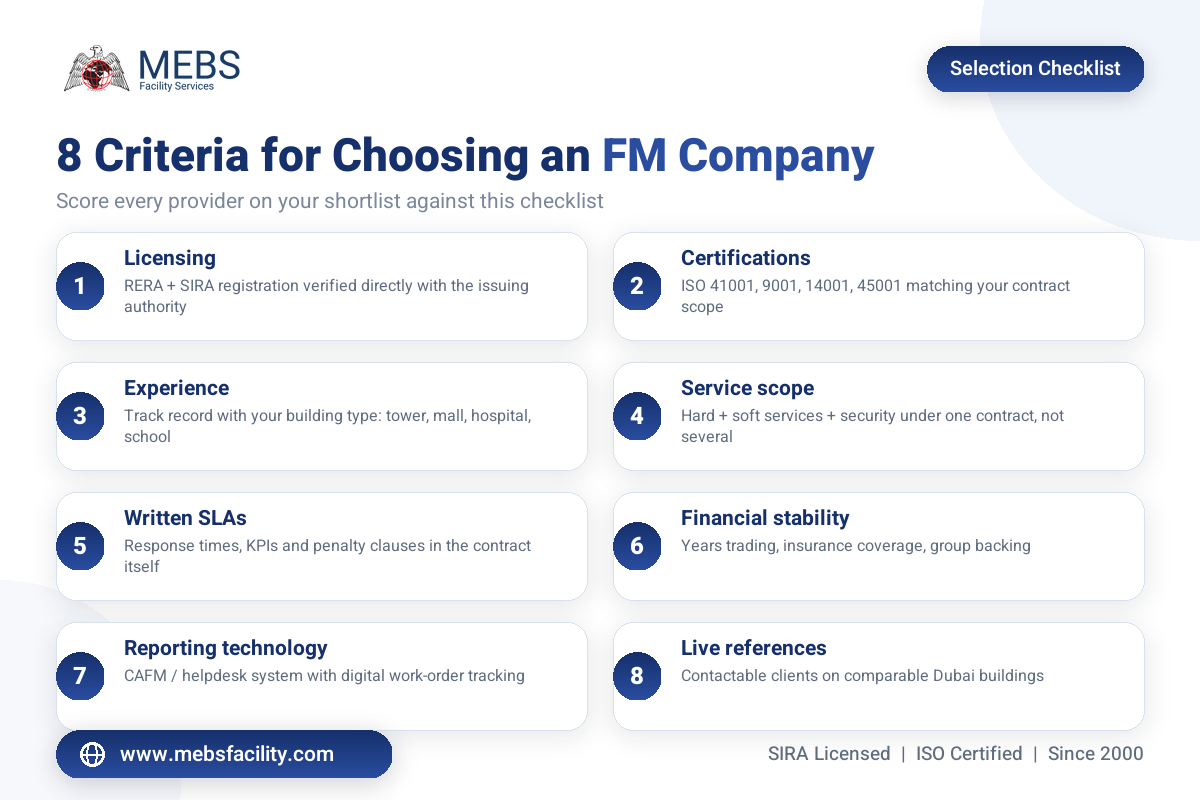
Use this checklist to compare providers side by side before you request formal proposals.
| Criterion | What to Check | Why It Matters |
|---|---|---|
| Licensing | RERA registration, SIRA licence for security scope, DED trade licence | Unregistered providers expose the building owner to compliance and insurance risk |
| Certifications | ISO 41001, 9001, 14001, 45001 with scope matching your contract | Signals documented, auditable processes rather than informal delivery |
| Relevant experience | Years managing buildings of your type: tower, mall, hospital, school | A residential tower and a hospital have very different compliance and SLA needs |
| Service scope | Hard services, soft services, security, all under one contract or split | Determines whether you get one accountable partner or several vendors to coordinate |
| SLA structure | Response times, KPIs, penalty clauses, reporting frequency in writing | Verbal promises are unenforceable; only a written SLA protects you at renewal or dispute |
| Financial stability | Years trading, insurance coverage, parent company or group backing | An undercapitalised provider is a bankruptcy or mid-contract exit risk |
| Technology and reporting | CAFM/helpdesk system, digital work-order tracking, dashboards | Determines whether you can see what was done, when, and verify it against invoices |
| References | Live references from comparable Dubai buildings, not just case studies | A reference call surfaces service issues that a proposal document will not |
Step-by-Step: How Do You Select a Facility Management Company in Dubai?
Selecting a facility management company is a structured process, not a single meeting. Buildings that rush it end up locked into a one to three year contract with a provider that was never a good fit.
Step 1: Define the Scope and Standard You Need
List every service the building needs, hard and soft, and set the standard expected for each: response times for reactive callouts, cleaning frequency by area, guarding hours and posts. This document becomes the basis for every quote you compare, so vague scopes produce quotes that cannot be compared fairly.
Step 2: Shortlist Providers With Verified Credentials
Pull a shortlist of three to five companies with confirmed RERA registration, SIRA licensing where security is included, and ISO certifications that match your scope. Verify licences directly with the issuing authority rather than trusting a claim on a company website.
Step 3: Request Detailed, Itemised Proposals
Ask for pricing broken down by service line, not a single lump sum. An itemised proposal lets you see where a low headline price is being subsidised by under-servicing a specific area, such as a thin preventive maintenance schedule hidden inside a competitive-looking total.
Step 4: Check References and Site-Visit an Active Contract
Speak to at least two current clients with a similar building type, and if possible visit a site the provider actively manages. A reference call reveals response-time reality and how disputes get resolved, which a proposal document never will.
Step 5: Negotiate SLAs and Confirm the Exit Clause
Before signing, get response times, KPIs, reporting cadence and penalty clauses written into the contract, not left as a verbal understanding. Confirm the notice period and exit terms too, since a provider that will not agree reasonable exit terms is signalling how a dispute would likely go.
In-House vs Outsourced Facility Management: Which Is Right for You?
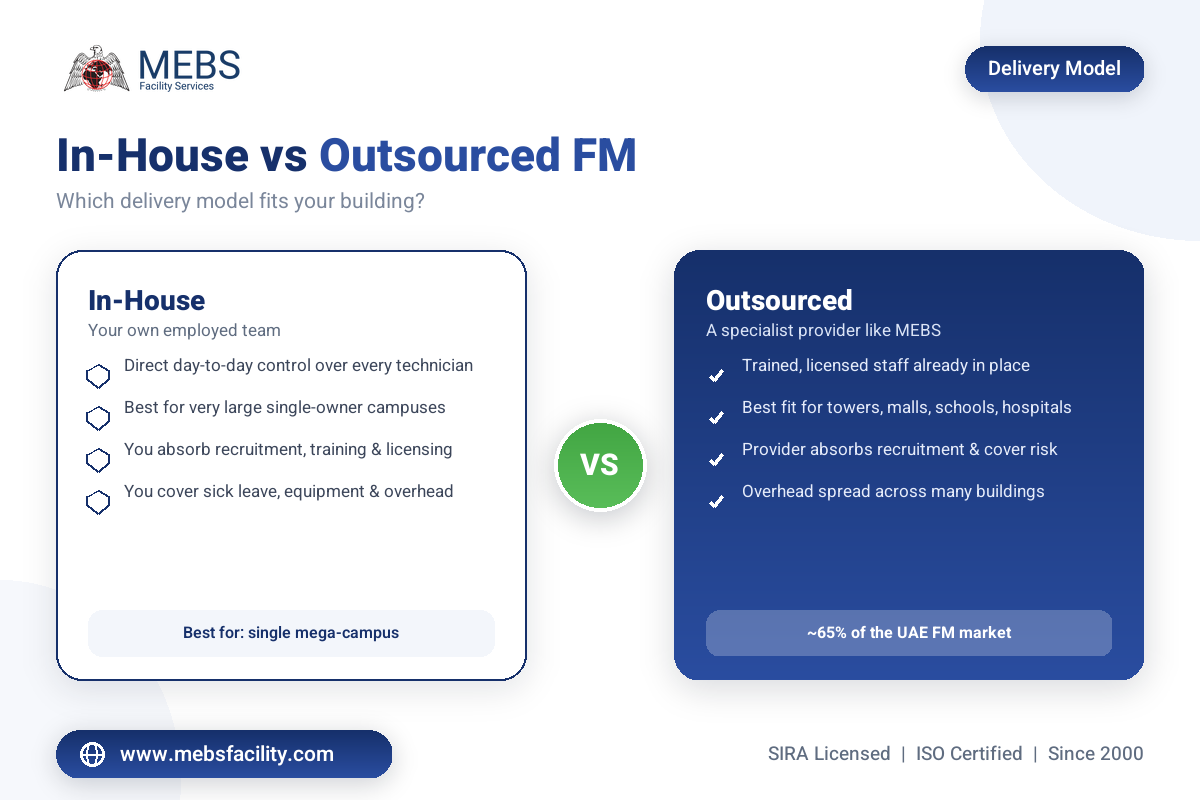
In-house facility management means the building owner or operator employs its own maintenance, cleaning and security staff directly. Outsourced facility management means a specialist company like MEBS supplies and manages that labour under contract.
In-house works best for very large single-owner campuses with the scale to justify a dedicated internal team, and for organisations that want direct day-to-day control over every technician and cleaner on site. The tradeoff is that the owner absorbs recruitment, training, licensing, sick leave cover, equipment and management overhead directly.
Outsourced facility management works best for the majority of Dubai commercial buildings: towers, malls, schools, hospitals and mixed-use developments where the operator's core business is not staffing a maintenance department. A specialist provider brings trained, licensed staff already, absorbs the recruitment and cover risk, and spreads its overhead across many buildings rather than one.
The market data reflects this trade-off directly: outsourced delivery already covers roughly 65 percent of the UAE facility management market, and outsourced facility management is growing faster than in-house provision as more owners decide the specialisation is worth paying for.
What Questions Should You Ask Before Signing an FM Contract?
A good facility management company answers these questions clearly and in writing. A provider that becomes vague, defensive or evasive on any of them is telling you something.
- What is your average technician-to-property ratio, and who is our named account manager?
- Can you show current RERA, SIRA and ISO certificates covering exactly the services we are contracting?
- What is your guaranteed response time for emergency, urgent and routine reactive callouts?
- How do you handle staff cover during sick leave, annual leave and public holidays?
- What reporting do we receive, how often, and through what system?
- How are disputes and service failures handled under the contract, and what are the penalty clauses?
- Can you provide three references from buildings comparable to ours, contactable directly?
- What is included in the base price, and what is billed as a variation or additional work order?

What Red Flags Should You Watch For When Evaluating FM Companies?
Some warning signs are visible before a contract is even signed, if you know where to look.
- Pricing far below every other quote. Facility management is a labour-intensive, licence-heavy business. A quote significantly under the market range usually means under-staffing, under-servicing preventive maintenance, or using unlicensed subcontractors.
- Reluctance to name specific staff or show licences. A provider that cannot produce a named account manager or current RERA/SIRA/ISO documentation on request is not ready to be accountable once the contract starts.
- No written SLA, only a verbal assurance. "We'll take care of it" is not a service level agreement. If response times and KPIs are not in the contract, they do not exist when something goes wrong.
- No client references, or references that dodge direct contact. Case studies are marketing. A live phone call with a current client is verification.
- High staff turnover on the sales side but no operational continuity plan. Ask what happens to service quality if your assigned supervisor leaves; a mature provider has a documented handover process.
- Single-point subcontracting with no oversight. Some providers win the contract and then subcontract the actual delivery to a third party at a lower rate, keeping the margin and diluting accountability. Ask directly whether any part of the scope will be subcontracted.
How Do You Evaluate SLAs and Compliance Reporting?
A service level agreement is the document that turns a sales pitch into an enforceable standard. Evaluating one properly means reading past the headline promises to the mechanics underneath.
Response times should be tiered by urgency: emergency (life safety, flooding, power failure), urgent (lift breakdown, AC failure in occupied space) and routine (a dripping tap, a burnt-out bulb). A single blanket "24 hour response" for every issue is not a real SLA structure.
KPIs should be measurable, not aspirational. "High-quality cleaning" is not a KPI. "95 percent of scheduled cleaning tasks completed and logged per shift, verified by supervisor sign-off" is.
Reporting should arrive on a fixed cadence, cover completed versus scheduled work, and flag any KPI breaches with a stated remediation path, not just a monthly summary that reads well but says little.
Penalty and escalation clauses matter more than most owners realise at signing. A contract with no consequence for missed SLAs relies entirely on the provider's goodwill to hold standards once the relationship becomes routine. Ask for service credits or defined remediation steps tied to specific KPI breaches, and confirm the escalation path if a problem is not resolved at supervisor level.
How Long Should a Facility Management Contract Term Be?
Most facility management contracts in Dubai run between one and three years. Neither length is inherently better; the right term depends on how confident you are in the provider before you sign and how much price benefit a longer commitment buys you.
Shorter terms (one year) give you more flexibility to switch if service quality slips, and they suit buildings taking on a new provider for the first time, where an unproven relationship benefits from an early exit option. The tradeoff is typically a slightly higher rate and less incentive for the provider to invest in long-term asset planning for your building.
Longer terms (two to three years) usually secure better pricing and give the provider reason to invest in your specific assets, since the cost of onboarding is spread over a longer period. They only make sense once you have verified the provider's performance, either through a trial period, strong references, or an existing relationship on a different property.
Whichever term you choose, the notice period and exit clause matter more than the headline duration. A three year contract with a fair 60 to 90 day exit clause is a safer commitment than a one year contract that locks you in with no early termination route at all. Many Dubai buildings formalise the maintenance portion of this relationship as an annual maintenance contract alongside the wider FM scope, which is worth understanding before you negotiate term length.
How Much Does Facility Management Cost in Dubai?
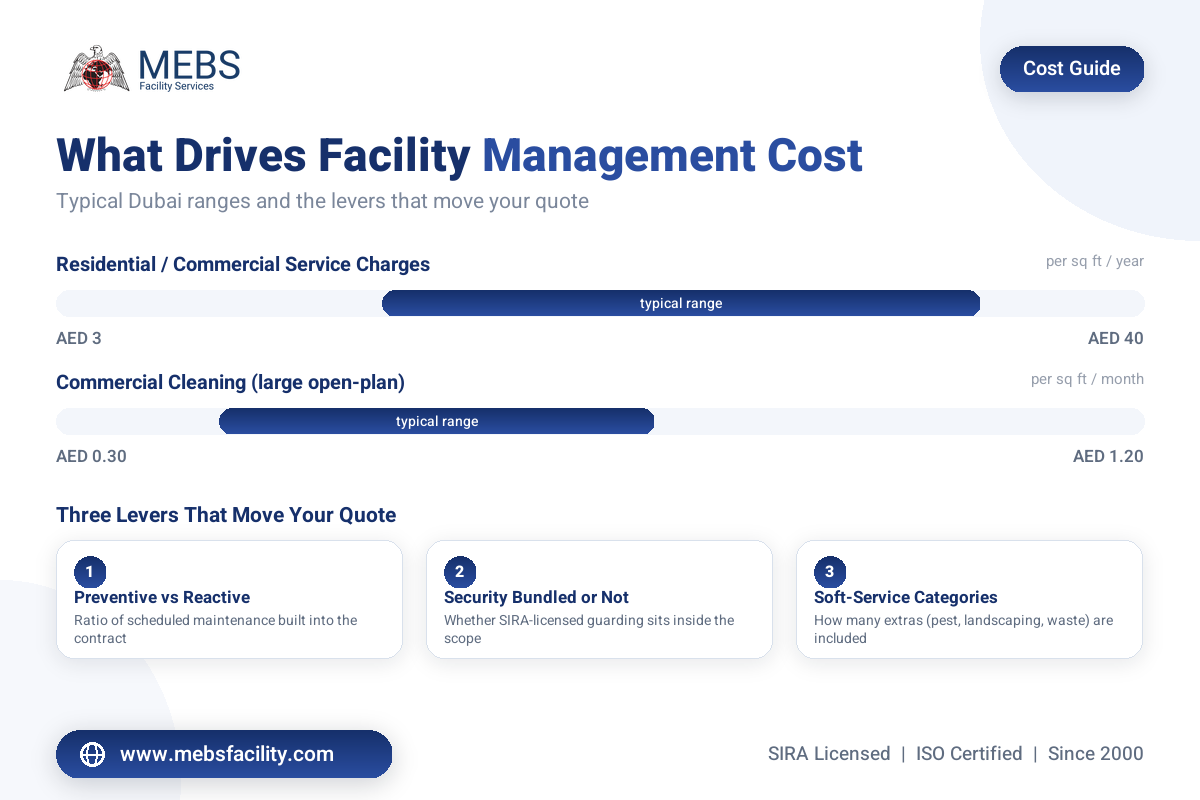
Facility management costs in Dubai vary by scope, building type and service standard, so treat any generic "average price" with caution. What is useful is understanding the components that drive the number.
Residential and commercial service charges, which fund building-wide facility management among other costs, typically range from around AED 3 to AED 40 per square foot depending on the community, building age and amenity level, with most mid-market towers sitting closer to AED 10 to AED 30 per square foot. Commercial cleaning alone, one component of a full FM contract, generally runs AED 0.30 to AED 1.20 per square foot per month for large open-plan spaces.
Three factors move the number more than any single line item: the ratio of preventive to reactive maintenance built into the contract, whether security is bundled in or contracted separately, and how many soft-service categories (cleaning, pest control, landscaping, waste management) are included versus billed as extras.
The cheapest quote is rarely the cheapest outcome. A contract priced to win on the headline number and recovered through change orders and under-servicing typically costs more over a three year term than a fairly priced, fully scoped contract from the start. Ask every shortlisted provider for the same itemised scope so the comparison is genuine.
What Services Should an Integrated FM Provider Bundle Together?
The most efficient facility management contracts in Dubai bundle related services under one provider rather than splitting them across specialists who do not talk to each other.
- Hard services: HVAC maintenance, electrical systems, plumbing, fire alarm and firefighting system servicing, lift and escalator maintenance, building management system (BMS) monitoring
- Soft services: daily and periodic cleaning, pest control, landscaping and irrigation, waste management, pool and water feature maintenance
- Security: SIRA-licensed guarding, CCTV monitoring and maintenance, access control, visitor management
- Compliance support: Civil Defence NOC coordination, water tank cleaning and certification, indoor air quality monitoring, ESG and sustainability reporting
Bundling does not mean every building needs every service from one provider. It means the services that interact operationally, such as fire safety maintenance and security response, or cleaning schedules and pest control, should sit with a provider that coordinates them rather than leaving the coordination gap to the building manager.
How Do You Match an FM Company to Your Property Type?
A shopping mall, a hospital, a school and a residential tower need facility management providers with different specialisations, even though the service categories look similar on paper.
Malls need 24/7 coverage, high-frequency cleaning during trading hours, SIRA-compliant security at scale, and fire and life safety systems sized for large occupant loads. Downtime during trading hours has a direct revenue cost for tenants, so response times matter more than almost anywhere else.
Hospitals and clinics need infection-control-aware cleaning protocols, uninterrupted power and HVAC (air quality directly affects clinical outcomes), and maintenance teams comfortable working around live patient areas without disrupting care.
Schools need providers who can schedule heavy maintenance and deep cleaning around term dates, apply higher hygiene standards in high-touch areas, and pass background-checked, SIRA-licensed security staff around children.
Residential towers need transparent service-charge reporting to the Owners Association, RERA-aligned administrative supervision, and a helpdesk residents can actually reach, since resident satisfaction directly affects an Owners Association's ability to set service charges.
Commercial offices and mixed-use developments need a provider comfortable balancing multiple tenant requirements under one roof: different fit-out standards, staggered service hours, and a helpdesk that can triage a tenant complaint without escalating every minor issue to building management. Consistency across common areas matters as much as any single hard-service metric here, since it is what tenants and their visitors actually notice day to day.
The same due-diligence habit applies whether you are vetting a full FM provider or a single-service specialist. Our companion guide on how to choose a security company in Dubai walks through the same licence and reference checks in more depth for the guarding component alone.
When you compare proposals, weight experience with your specific property type more heavily than a provider's total portfolio size. A large FM company with no hospital experience is a worse fit for a clinic than a smaller specialist that already runs three, and a provider whose track record is entirely residential towers will need to prove it can handle a mall's trading-hour intensity before you hand over the keys.
Why Choose MEBS Facility Services as Your Dubai FM Partner?
MEBS Facility Services has delivered integrated facility management across Dubai and the wider UAE since 2000, combining security, cleaning and building maintenance under one SIRA-licensed, ISO-certified contract.
Buildings that work with MEBS get one accountable helpdesk instead of three vendor numbers, a documented SLA with real response-time commitments, and a track record across residential towers, retail, hospitality, schools and commercial offices. Our teams already hold the certifications and licences this guide describes, so verifying them is a straightforward conversation rather than a leap of faith.
If you are comparing facility management companies in Dubai for a building, an MEBS Facility Services consultation gives you an itemised, scope-matched proposal you can hold against every other quote on your shortlist. Contact our team to start the comparison.