



Integrated facility management (IFM) for Dubai malls combines maintenance, cleaning, security, fire safety and lift compliance into one accountable contract instead of a dozen separate vendors. A single IFM partner manages SLAs, DCD fire compliance, SIRA-licensed security and daily operations, reducing coordination gaps and giving mall owners one point of contact.
A shopping mall is not one building, it is dozens of systems running at once. Chillers cooling a million square feet of retail. Fire alarm panels wired to every tenant unit. Escalators moving thousands of shoppers an hour. CCTV covering every entrance, till and car park level. Cleaning crews working food courts before the first customer arrives.
Managing each of those as a separate contract is how malls end up with a dozen vendors, a dozen invoices, and no single person accountable when something fails. Integrated facility management exists to fix exactly that problem, and for malls specifically, it has become the standard operating model rather than a nice-to-have.
What Is Integrated Facility Management for Malls?
Integrated facility management is a service model where one provider takes contractual responsibility for a mall's hard and soft services under a single agreement, instead of the owner managing separate specialists for each discipline. For a mall, that typically means one company is accountable for the following.
-
Hard services: MEP, HVAC, electrical, plumbing, fire and life safety systems, lifts and escalators
-
Soft services: cleaning, waste management, landscaping and pest control
-
Security services: SIRA-licensed guarding, CCTV monitoring and access control
-
Compliance management: Dubai Civil Defence, SIRA and Dubai Municipality certifications kept current
The defining feature is not the list of services, it is the single point of accountability. When a chiller fails at 2am on a Friday, the mall operations manager makes one call, not four.
Why Do Dubai Malls Need an IFM Model?
Dubai's malls operate at a scale that makes fragmented vendor management genuinely risky. The Dubai Mall alone covers roughly 12.1 million square feet, with over 1,200 retail outlets and more than 160 food and beverage venues trading every day of the year. Even a mid-sized regional mall runs cooling, fire, security and cleaning systems around the clock, seven days a week.
At that scale, a multi-vendor model creates three recurring problems: slower incident response because no one owns the whole picture, compliance records scattered across separate companies, and disputes over which vendor is responsible when a system fails at the boundary between two contracts, such as a fire alarm fault that could be electrical or fire-system related.
IFM removes that ambiguity. One provider, one set of SLAs, one team that already knows the building.
What Services Does IFM Bundle for a Shopping Mall?
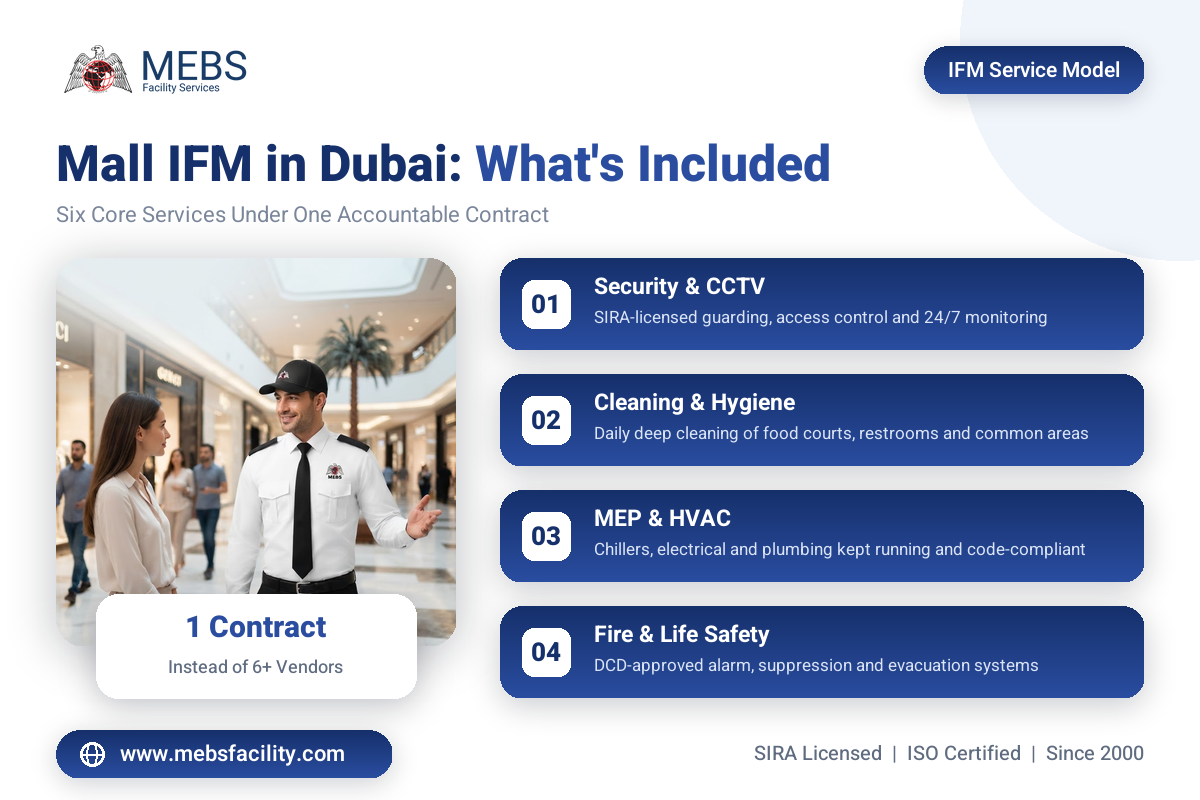
A mall-grade IFM contract typically bundles the following services under one provider and one SLA structure.
-
Security and CCTV: SIRA-licensed guards, access control at service and staff entrances, and CCTV monitoring across common areas, car parks and back-of-house zones
-
Cleaning and hygiene: daily deep cleaning of food courts, restrooms, escalators and shared circulation areas, scaled to footfall
-
MEP and HVAC: chillers, electrical distribution, plumbing and building management systems kept running and code-compliant
-
Fire and life safety: DCD-approved alarm, suppression and voice evacuation systems, tested and serviced on schedule
-
Lifts and escalators: scheduled maintenance and third-party inspection to keep vertical transport certified and running
-
Landscaping and waste: external grounds, planting and mall waste and recycling management
Some mall owners also fold event support and vertical promotions into the same contract, since the same operations team is already on site managing the space.
How Big Is the Integrated Facility Management Market in the UAE?
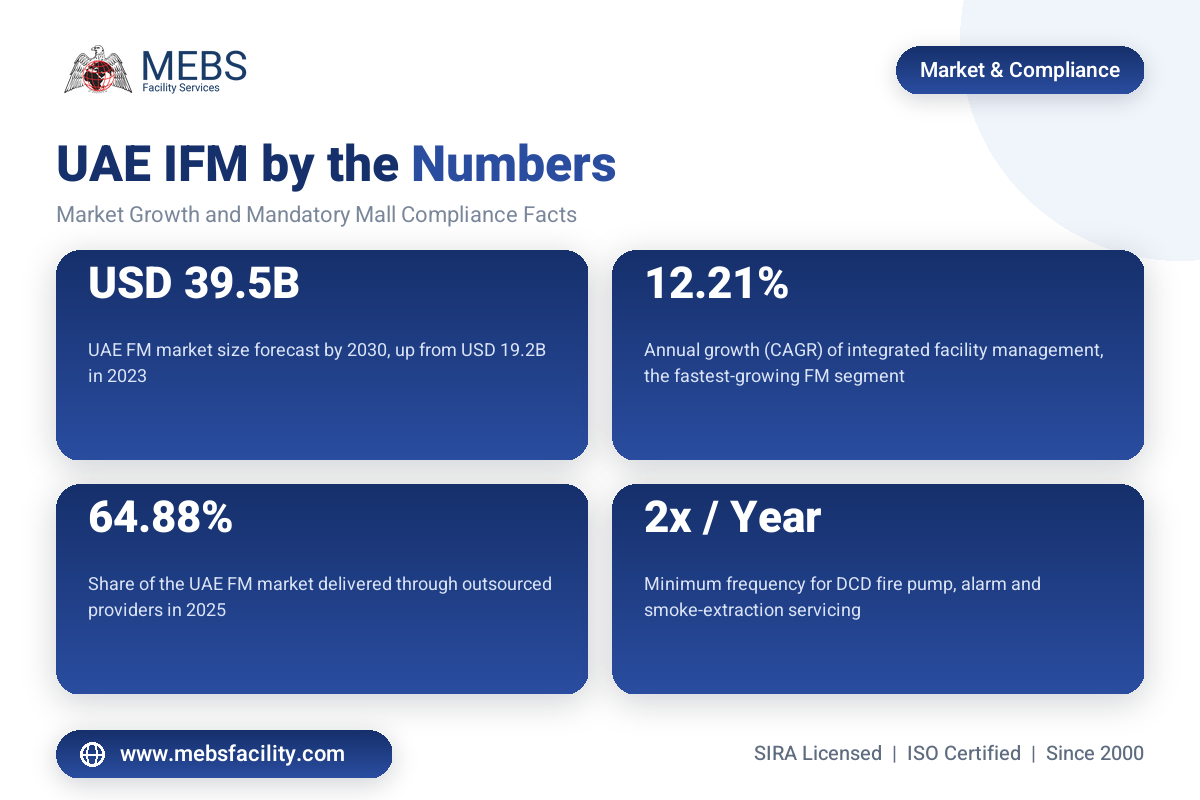
IFM adoption in the UAE is not a niche trend, it is the fastest-growing part of an already large market. The UAE facility management market generated approximately USD 19.2 billion in 2023 and is forecast to reach USD 39.5 billion by 2030, growing at roughly 10.9% a year.
Within that market, integrated facility management is growing faster than the sector average, at an estimated 12.21% annually, as owners consolidate multiple standalone contracts into single-provider agreements. Outsourced delivery, of which IFM is the leading model, already accounted for roughly 64.88% of the UAE facility management market in 2025.
For mall owners, that shift reflects a simple calculation: the cost of coordinating a dozen vendors, versus the cost of one contract with clear accountability, increasingly favours the single-provider model.
IFM vs Multi-Vendor Management: What's the Difference?
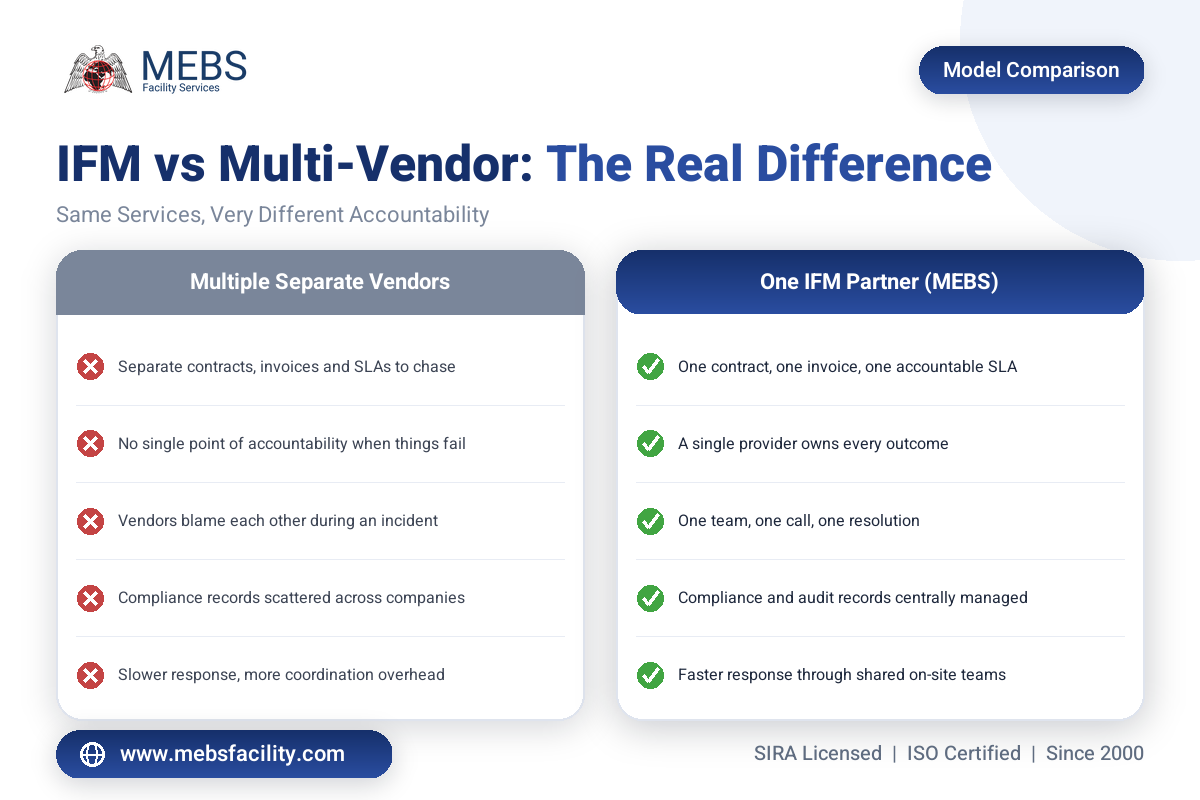
The services performed under IFM and under a multi-vendor model can look identical on paper. The difference is in accountability, response time and how compliance is managed.
| Factor | Multi-Vendor Model | Integrated FM Model |
|---|---|---|
| Accountability | Split across separate companies | One provider, one SLA |
| Incident response | Slower, needs coordination between vendors | Faster, shared on-site team |
| Compliance records | Scattered across vendors | Centrally managed and audit-ready |
| Contract admin | Multiple contracts, invoices, renewals | Single contract and invoice |
| Boundary failures | Vendors dispute responsibility | One team owns the outcome |
What SLAs Should a Mall Expect From an IFM Provider?
A serious IFM contract is only as good as the service level agreements behind it. Before signing, a mall owner should expect the provider to commit to the following in writing.
-
Defined response times for critical failures such as fire system faults, lift breakdowns or power loss, typically within 15 to 30 minutes on site
-
Scheduled preventive maintenance calendars for MEP, HVAC, fire systems and lifts, not just reactive callouts
-
A named account or facilities manager based on site, not a call centre ticket queue
-
Monthly or quarterly compliance and performance reporting covering fire, security and maintenance logs
-
Clear escalation paths and penalties for missed response times
How Does 24/7 SIRA-Compliant Security Fit Into Mall IFM?
Security is one of the most visible parts of a mall IFM contract, and one of the most tightly regulated. Every guard deployed must hold a valid SIRA licence, and the mall's CCTV system must meet SIRA's technical and retention standards, which for large shopping malls means a minimum 90-day footage retention period under the SIRA CCTV rules.
Under an IFM model, security is not managed in isolation. The same operations team that handles maintenance callouts also coordinates evacuation procedures with security staff, meaning fire wardens, guards and facilities engineers are working from one incident plan rather than three separate ones. Many mall owners fold this into a wider managed security service alongside SIRA CCTV operator cover, so guarding, monitoring and compliance sit with the same accountable partner as the rest of the building.
How Are Fire and Life Safety Systems Maintained Under IFM?
Fire and life safety is the single area where Dubai Civil Defence (DCD) enforcement is strictest, and it is a core hard-service component of any mall IFM contract. Key requirements include the following.
-
Addressable fire alarm systems, where each device is individually identifiable, connected to a centralised panel linked to the DCD monitoring network
-
A voice alarm system broadcasting evacuation instructions in Arabic and English, mandatory for high-occupancy buildings such as malls with more than 1,000 people
-
Fire pumps, alarm panels and smoke extraction fans serviced on a quarterly and annual schedule by a DCD-approved contractor, with logged servicing records
-
Any change to a tenant unit's fire system must be confirmed compatible with the mall's base-building fire panel before it is modified
Because fire systems sit at the intersection of MEP, electrical and life safety, this is exactly the kind of service that suffers most under a fragmented multi-vendor setup. Our guide to emergency preparedness for commercial buildings in Dubai covers the wider evacuation and readiness requirements that sit alongside these fire system rules.
How Are Lifts and Escalators Maintained Under IFM?
Lifts and escalators are the parts of a mall a customer touches most directly, and they are subject to their own regulatory track separate from fire safety. The UAE largely follows the European EN 81 series of lift standards, and Dubai Municipality requires certification before any lift is installed or brought into service.
-
Lifts and escalators must be inspected at least twice a year by an accredited third-party inspection body
-
High-traffic, high-rise buildings such as malls typically require monthly or quarterly preventive maintenance visits on top of the biannual inspection
-
Maintenance logs and inspection certificates must be kept current for both Dubai Municipality and Dubai Civil Defence review
-
Only accredited inspection bodies can issue the safety certificate insurers and authorities will accept
Under IFM, lift and escalator maintenance is scheduled alongside the mall's wider MEP calendar, so a technician already on site for HVAC or electrical work can also flag early wear on a escalator step chain before it becomes a breakdown during peak footfall.
What Does Mall Cleaning Look Like Under an IFM Model?
Cleaning in a mall is not a single service, it is several different cleaning regimes running in parallel. Food courts need multiple cleans a day. Restrooms need hourly checks during peak hours. Glass facades and atriums need scheduled specialist cleaning that ordinary janitorial staff are not equipped for.
Under IFM, cleaning schedules are built around the mall's actual footfall pattern rather than a fixed generic rota, and the same team that reports a cleaning issue can also flag a related maintenance fault, such as a leaking pipe behind a restroom wall, without waiting for a separate vendor visit.
How Do You Select an IFM Partner for a Mall?
Choosing an IFM provider is a longer-term decision than choosing a single-service vendor, because the whole point is consolidating accountability into one relationship. The selection process typically follows five steps.
Step 1: Define the Full Service Scope
List every hard, soft, security and compliance service the mall needs covered, and decide which, if any, will stay outside the IFM contract.
Step 2: Shortlist SIRA-Licensed, ISO-Certified Providers
Confirm each candidate holds a valid SIRA licence for security services and relevant ISO certifications for quality and safety management before evaluating anything else.
Step 3: Compare SLAs, Not Just Price
Request written response times, reporting frequency and named on-site staffing for each proposal, since the cheapest quote is rarely the one with the strongest SLA.
Step 4: Check Mall-Specific Experience
Ask for references from other retail or mall properties specifically, since retail footfall patterns and fire-life-safety requirements differ from office or residential buildings.
Step 5: Confirm the Transition and Reporting Plan
Agree how existing compliance records, maintenance history and staff will transition to the new provider, and how performance will be reported back to ownership.

Why Choose MEBS for Mall IFM?
MEBS has been SIRA-licensed and ISO-certified since 2000, running integrated facility management across Dubai commercial and retail properties. That means one team handles security, MEP, fire and life safety, lift coordination and cleaning under a single SLA, rather than a mall owner juggling separate contracts for each.
It is also the same principle mall owners should apply when they choose a security company in Dubai or evaluate any single-service vendor: a provider that already manages the wider building is better placed to spot problems before they become incidents. For malls specifically, that means fire, security and maintenance teams working from the same incident plan, on the same site, under the same accountable contract.