



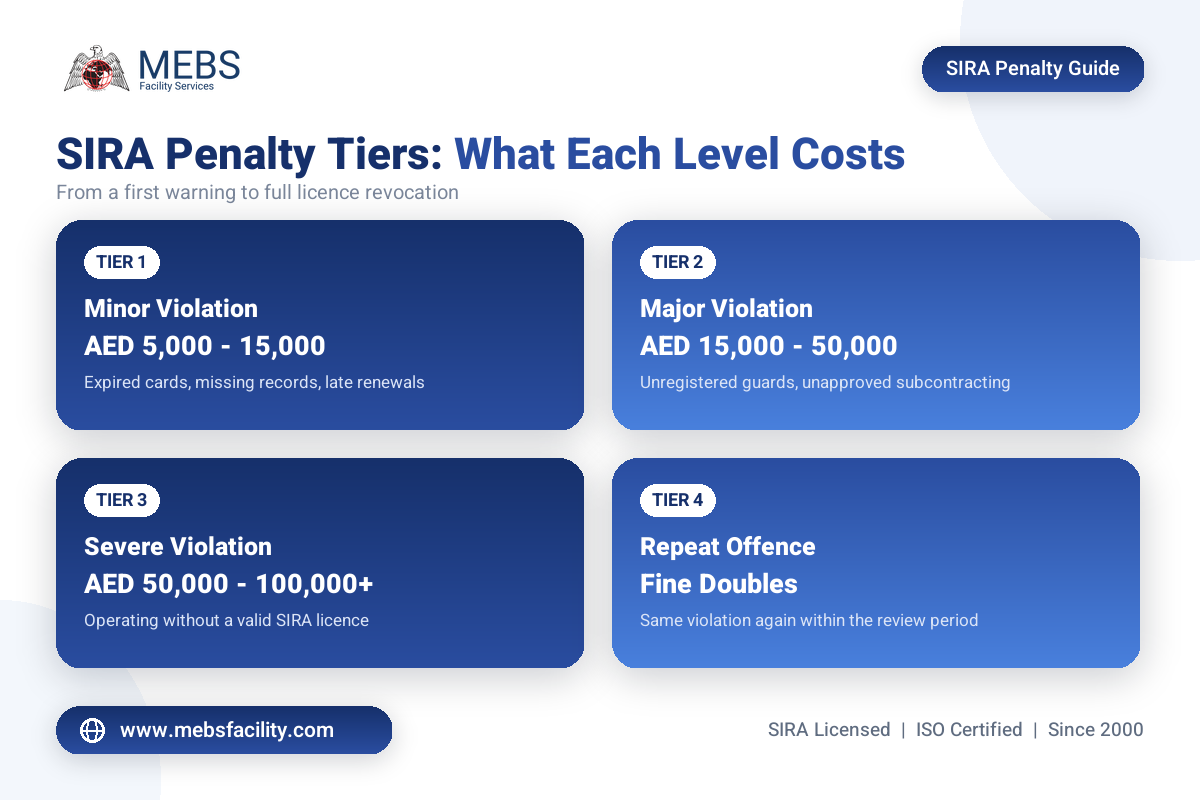
SIRA fines in Dubai typically range from AED 5,000 to over AED 100,000 depending on the violation. Minor issues like an expired guard card start around AED 5,000, unregistered staff can cost AED 15,000, and operating without a valid SIRA licence risks suspension, licence revocation, and fines exceeding AED 100,000.
Every year, Dubai businesses lose tens of thousands of dirhams to SIRA violations they didn't know existed. An expired guard card, a missing insurance certificate, or an unregistered team member can trigger fines fast, and repeat offences make the bill worse. This guide breaks down the full list of SIRA fines and violations in Dubai, explains how enforcement actually works, and shows you how to stay compliant before an inspection catches you off guard.
Whether you run a security company, manage a commercial building, or are simply planning event security in Dubai or residential compound, understanding these penalties is the first step to avoiding them. We will cover the exact fine ranges by violation type, what triggers a SIRA inspection in the first place, and the practical steps that keep a security operation permanently audit-ready rather than scrambling before every renewal deadline.

What Are SIRA Fines?
SIRA fines are administrative penalties issued by Dubai's Security Industry Regulatory Agency (SIRA) when a security company, guard, or CCTV operator breaches the rules set out under Law No. 12 of 2016 Regulating the Security Industry in the Emirate of Dubai. SIRA is the regulator that licenses every security guard, security company, and CCTV installer operating in Dubai, and it has the authority to inspect, fine, suspend, or shut down non-compliant operators.
Fines exist to protect the public and to keep the security industry accountable. A guard without a valid SIRA certification hasn't passed background checks or approved training, which is exactly the risk SIRA fines are designed to eliminate. For businesses, the fines are also a strong incentive to work only with licensed security providers rather than cutting corners on cost.
Penalties are applied on a case-by-case basis depending on the severity of the breach, whether it is a first offence, and how quickly the company corrects the issue. There is no single public fee schedule for every possible violation, but based on documented industry cases and SIRA's compliance framework, fines generally fall into the tiers below.
It helps to understand that SIRA regulates at two levels: the company and the individual. A security company holds a SIRA accreditation covering the categories of service it is approved to provide, whether that is manned guarding, CCTV monitoring, or cash-in-transit. Each guard, supervisor, or CCTV operator then holds a personal SIRA card tied to their role and training level. A violation can occur at either level, and in many real cases it occurs at both simultaneously, which is exactly what turns a single missed renewal into a compounding fine.
Full List of SIRA Violations and Penalties in Dubai
The table below summarises the most common SIRA violations reported by security companies and compliance consultants in Dubai, along with the typical penalty range and consequence for each. Figures reflect real cases and industry-reported ranges; SIRA determines the exact fine for each incident individually, so always confirm current amounts through the SIRA portal or your compliance officer.
| Violation | Typical Penalty (AED) | Consequence |
|---|---|---|
| Guard working with an expired SIRA card | AED 5,000 per guard | Guard barred from duty, mandatory compliance review |
| Unregistered or unlicensed guard on site | AED 15,000+ (scales with duration) | Remediation order, guard removed from site |
| Missing or outdated staff or company documentation | AED 5,000 - 15,000 | Warning notice, follow-up audit |
| Unapproved subcontracting of security services | AED 15,000 - 50,000 | Contract voided, company placed under review |
| CCTV or systems installed without SIRA approval | AED 5,000 - 50,000 | System shutdown order, re-inspection required |
| Operating a security business without a valid SIRA licence | AED 50,000 - 100,000+ | Immediate suspension, forced closure, possible blacklisting |
| Repeat offence within the review period | Fine doubles | Escalated enforcement, risk of licence suspension |
| Fraud, malpractice, or serious misconduct | Fines plus potential prosecution | Criminal liability for the company and individual guard |
Notice how quickly the numbers escalate. A single unregistered guard working for three months can already cost a company around AED 15,000 in fines, and that is before SIRA orders any remediation. Multiply that across an 11-guard site with expired cards and the exposure can run into six figures.
It is worth noting that these figures represent typical, documented ranges rather than a fixed government price list. SIRA reserves the right to adjust a fine based on the specific circumstances of a case, including how long the violation persisted, whether it caused any harm or complaint, and whether the company cooperated with the inspection. Two companies committing what looks like the same violation on paper can end up with different fines depending on these factors, which is another reason to treat every SIRA requirement as non-negotiable rather than trying to estimate an "acceptable" level of risk.

What Happens If a Security Guard's SIRA Card Expires?
Every SIRA-licensed guard carries a personal SIRA card that proves they passed background checks and approved training. Once that card expires, the guard is no longer legally permitted to work, and any company that keeps them on duty is exposed to fines of roughly AED 5,000 per guard.
The problem compounds fast in larger teams. A facility running 10 or more guards with even a handful of expired cards can face tens of thousands of dirhams in fines in a single inspection, plus a mandatory SIRA compliance review that disrupts operations. Renewal typically needs to start at least 30 days before the expiry date to leave room for processing delays.
This is why serious providers track every card's expiry date centrally rather than relying on individual guards to self-report. MEBS's licensed security guards are monitored on a rolling renewal schedule specifically to avoid this exposure for clients.
Card expiry is one of the most common findings in SIRA inspections precisely because it is easy to overlook. A guard's card can lapse quietly in the middle of a busy contract cycle, especially at sites with high staff turnover or where guards are shared across multiple locations. Building a simple internal tracker, or better yet automating renewal reminders, removes almost all of this risk without any extra cost to the business.
What Are the Penalties for Operating Without a SIRA Licence?
Operating a security business, or providing guarding, CCTV monitoring, or cash-in-transit services, without a valid SIRA licence is treated as one of the most serious violations in the framework. Penalties for unlicensed operation can run from AED 50,000 to over AED 100,000, alongside immediate suspension of activities.
Beyond the fine itself, an unlicensed operator faces:
-
Forced closure of the security operation until licensing is resolved
-
Confiscation of unauthorised equipment, including CCTV systems and communication devices
-
Potential blacklisting from future SIRA licensing applications
-
Legal exposure under Dubai's security industry law, including possible criminal referral for serious cases
For a mid-size operation, a suspension alone can translate into roughly AED 100,000 in lost contract revenue while the business sits idle waiting on SIRA's review. That is separate from, and often larger than, the actual fine.
How Does SIRA Detect Violations?
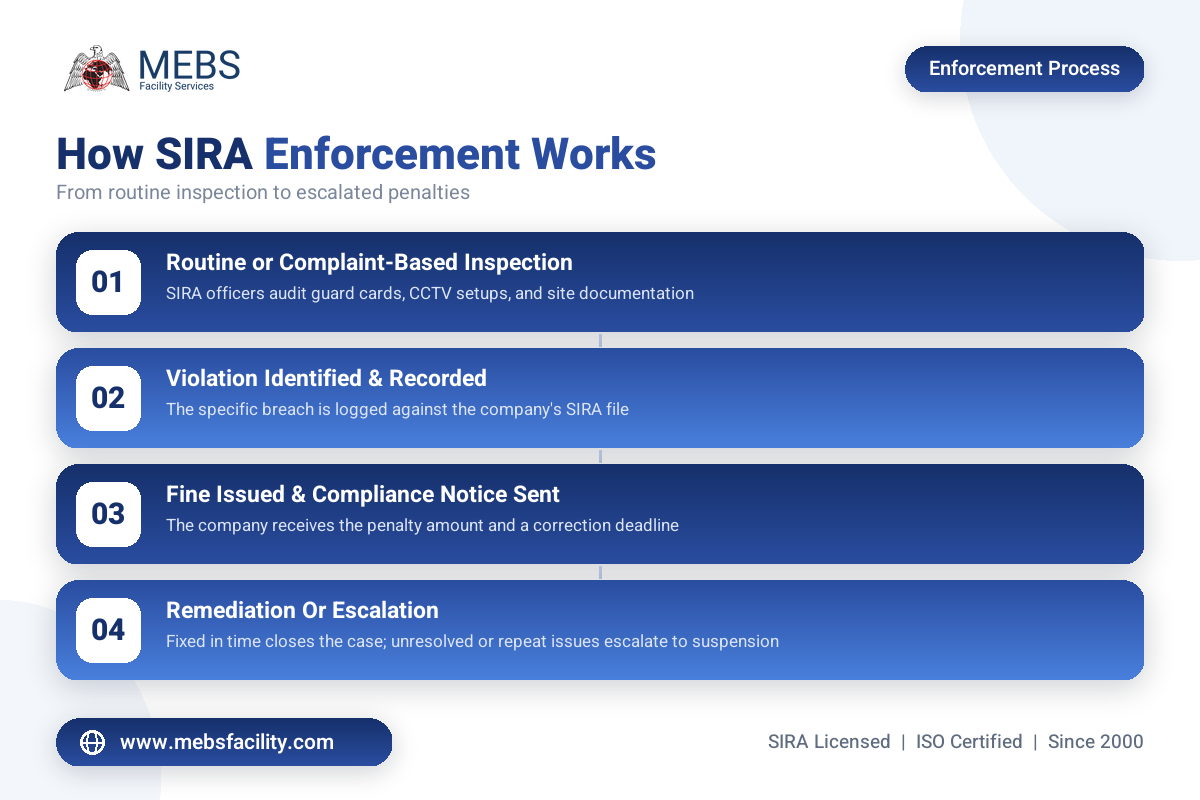
SIRA uses a mix of scheduled audits, surprise inspections, and complaint-driven investigations to catch non-compliant operators. Inspectors typically check guard cards against the SIRA database on the spot, review CCTV registration and footage retention, and audit company paperwork including insurance certificates and trade licences.
Common triggers for a SIRA inspection include:
-
Routine scheduled audits as part of annual company accreditation renewal
-
Complaints from clients, competitors, or members of the public
-
Incidents on site that require a police or SIRA report
-
Random spot checks at malls, residential towers, and commercial buildings
Because guard cards and company accreditations are logged in a central SIRA database, an inspector can verify status within minutes. There is no realistic way to "hide" an expired card or an unregistered guard once an inspection begins, which is why proactive compliance is far cheaper than reactive fixes.
Do Fines Double for Repeat Offences?
Yes. SIRA's enforcement approach escalates penalties for companies that repeat the same violation within a defined review period, and industry compliance guidance consistently confirms that fines double on a second offence. A violation that cost AED 15,000 the first time can become AED 30,000 the second time, with a heightened risk of suspension if the pattern continues.
This escalation is intentional. SIRA wants to see genuine remediation, not a company that pays a fine and quietly continues the same practice. A third or fourth repeat of the same violation moves a company into serious risk territory, including potential accreditation review or non-renewal.
The review period that determines whether a violation counts as a "repeat" is set case by case rather than published as a fixed number of months, which is another reason to close out any compliance notice completely rather than assuming the issue is behind you once the fine is paid. Keeping a written record of every corrective action taken, including dates and supporting documents, gives a company a strong position if a similar issue is flagged again months later.
How Does Non-Compliance Affect Insurance and Trade Licence Renewal?
SIRA fines rarely stay contained to the fine itself. Insurance providers that cover security operations typically require proof of active SIRA accreditation and guard licensing as a condition of the policy. A recorded violation, especially an unlicensed operation or a suspension, can result in a rejected claim if an incident occurs while the company was non-compliant.
Trade licence renewal with Dubai Economy and Tourism (DET) is also affected. Security companies must maintain valid SIRA accreditation alongside their DET trade licence, and an active SIRA suspension or unresolved violation can delay or block trade licence renewal until the compliance issue is resolved.
In practice, one unresolved SIRA violation can cascade into three separate business problems: the fine itself, a weakened insurance position, and a stalled trade licence renewal. That is a heavy price for what often starts as a missed renewal date.
Property owners and facility managers who hire a security provider should ask to see proof of current SIRA accreditation as standard practice, the same way they would check a contractor's insurance certificate. If a provider is reluctant to share this documentation, treat it as a warning sign rather than an oversight, because the client site can end up carrying reputational and contractual fallout even when the fine itself is issued to the security company.
Who Is Responsible for Paying SIRA Fines, the Company or the Guard?
In almost all cases, the licensed security company carries primary responsibility for SIRA compliance and any resulting fines, since the company holds the SIRA accreditation and is contractually responsible for deploying only licensed, compliant staff. This applies whether the guard is a direct employee or supplied through a subcontractor.
Individual guards can face separate consequences too, including job termination and, in cases of fraud or serious misconduct, personal fines or referral for prosecution. This is exactly why choosing an accredited security company matters for the client commissioning the service: if your provider's compliance lapses, your site is the one exposed to the operational disruption of a sudden suspension.
What Is the True Cost of Non-Compliance Beyond the Fine?
The AED figure on a SIRA violation notice is rarely the full cost. Businesses that get flagged for non-compliance typically absorb several layers of expense:
-
Direct fines, ranging from AED 5,000 to over AED 100,000 depending on severity
-
Lost revenue during suspension, which can reach approximately AED 100,000 for a mid-size operation
-
Remediation costs, including emergency guard replacement and expedited licensing
-
Reputational damage with clients, insurers, and property managers who require proof of compliance
-
Higher insurance premiums at renewal following a recorded violation
When you add these together, a single SIRA violation can cost a business many multiples of the headline fine. That is the real argument for building compliance into daily operations rather than treating it as a once-a-year paperwork exercise.
There is also a quieter cost that rarely shows up on a balance sheet: client trust. Malls, schools, hospitals, and residential towers in Dubai increasingly ask for compliance documentation before signing or renewing a security contract. A provider with a recent SIRA violation on file may lose out on tenders entirely, regardless of how the fine itself was resolved, simply because procurement teams now treat SIRA history as a due-diligence checkpoint.
How Can Businesses Stay SIRA Compliant?
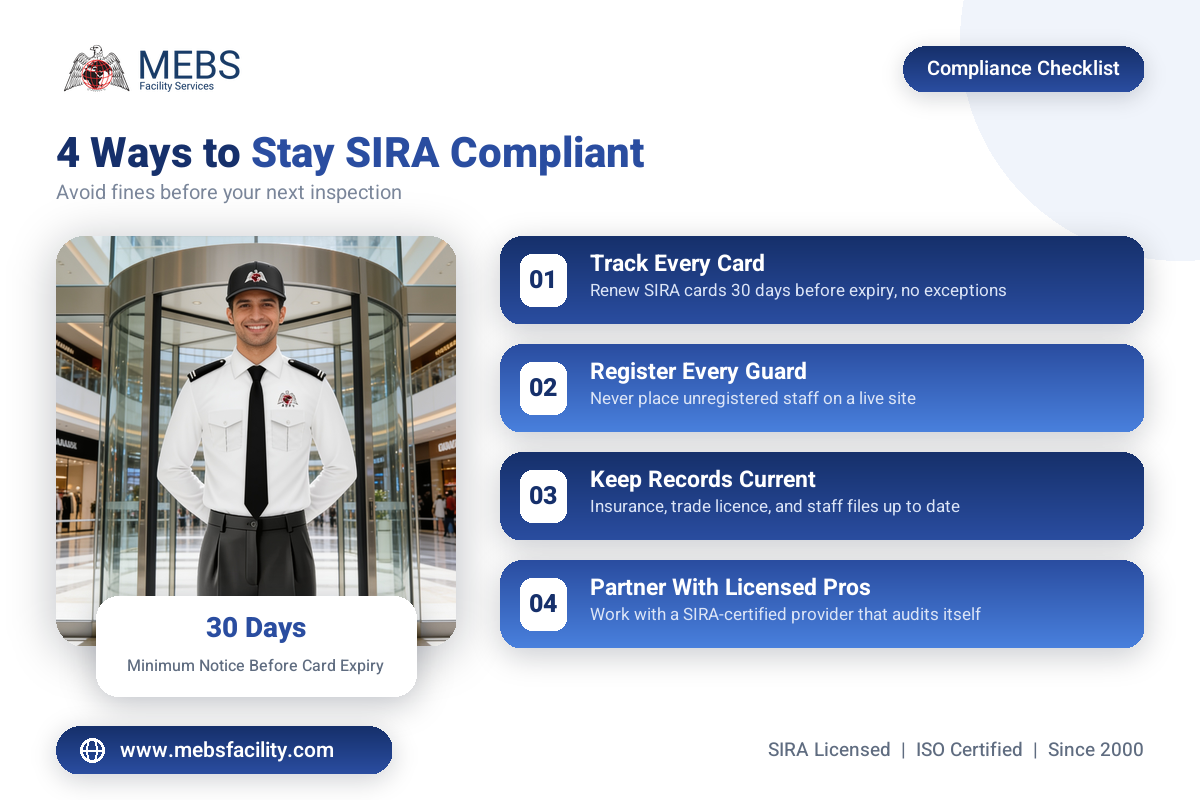
Staying compliant with SIRA is less about a single action and more about an ongoing system. The checklist below covers the core habits that keep security operations audit-ready year-round.
-
Track every guard card's expiry date centrally and start renewals at least 30 days early
-
Register every guard with SIRA before they set foot on a client site, with no informal or "temporary" placements
-
Keep company documentation current, including insurance certificates, DET trade licence, and staff records
-
Approve subcontracting arrangements with SIRA before using third-party guards or agencies
-
Register CCTV and security systems with SIRA before installation, not after
-
Run internal audits on a quarterly basis rather than waiting for SIRA's own inspection schedule
-
Partner with a SIRA-certified provider that already carries this administrative burden
Businesses that manage security in-house often underestimate how much staff time this compliance workload requires. It is one of the main reasons Dubai property managers and facility owners outsource to a licensed security services provider instead of managing guard licensing internally.
Why Should You Hire a SIRA-Certified Security Provider?
A SIRA-certified provider like MEBS carries the compliance burden so your business does not have to. That means every guard deployed to your site already holds a valid, verified SIRA card, every subcontracting arrangement is pre-approved, and every CCTV system is registered correctly from day one.
MEBS has operated as a SIRA-licensed, ISO-certified facility and security services company in Dubai since 2000, serving high-rises, malls, schools, and hospitals across the emirate. Choosing an accredited partner is not just about avoiding fines for your provider, it is about protecting your own business from the operational fallout of someone else's non-compliance on your property.
If your current guarding arrangement was set up informally, or you inherited a contract without checking the provider's SIRA status, it is worth a compliance review before your next renewal. Our team can walk you through exactly what to check.
Beyond guarding, MEBS also manages CCTV monitoring, housekeeping, and building maintenance under the same accountable-partner model, which means clients deal with one licensed provider instead of juggling separate vendors and separate compliance risks for each service. For facility owners managing multiple properties, this consolidation is often what turns SIRA compliance from a recurring headache into a solved problem.
Frequently Asked Questions
Key Takeaways
SIRA fines in Dubai are designed to keep the security industry accountable, and they scale quickly once a violation is left unresolved. An expired card starts at roughly AED 5,000 per guard, an unregistered guard can cost AED 15,000, and operating without a licence risks fines of AED 100,000 or more alongside suspension. Repeat offences double the penalty, and the knock-on effects on insurance and trade licence renewal often outweigh the fine itself.
The most reliable way to avoid all of this is to work with a provider that treats SIRA compliance as a daily operational discipline, not an annual paperwork exercise. MEBS has been SIRA-licensed and ISO-certified in Dubai since 2000, managing guard licensing, CCTV registration, and documentation so clients never carry that risk. Explore our careers page if you are a licensed guard looking for compliant, stable placements, or reach out to discuss your site's security needs.